
· 9 min read
Most expats find out the hard way: you can pay tax twice on the same income, and nobody explains how to stop it until you've already overpaid. I lived this myself, moving between Kuwait, India, and the UK long before I built Settel - and the foreign tax credit system that's supposed to fix double taxation is exactly the kind of thing nobody walks you through properly.
A foreign tax credit lets you offset tax you've already paid abroad against what you owe at home, so the same income isn't taxed twice. Most expats earning across the US, UK, India, and UAE corridors are leaving real money on the table because the rules are confusing and a lot of the advice out there is out of date. This guide tells you exactly how to claim foreign tax credits correctly in 2026 — what's actually changed, what hasn't, and where people get it wrong.
Table of Contents
- Understanding Foreign Tax Credits: Preventing Double Taxation
- Common Pitfalls And Legislative Updates Impacting Expat Tax Credits In 2026
- Comparing Foreign Tax Credit Regimes: US, UK, India, And UAE
- Practical Strategies For Expats To Maximise Their Tax Credits In 2026
- Simplify Your Expat Tax Strategy With Settel
Key takeaways
| Point | Details |
|---|---|
| Foreign tax credits offset taxes paid abroad | They prevent you from paying tax twice on the same income by crediting foreign tax against your domestic tax bill. |
| Most expats underuse credits due to complexity | Limitation formulas, carryover rules, and treaty restrictions cause many to miss out on significant savings. |
| Two real US legislative changes apply for 2026 | A $6,000 deduction for taxpayers 65+ affects the FTC limitation formula, and a narrow new rule limits credit on certain GILTI-related income for CFC shareholders. Most other FTC mechanics are unchanged. |
| UK's FIG regime offers time-limited full exemption | Newcomers get up to four years of exemption on foreign income and gains, replacing the old indefinite remittance basis — though claiming it means losing your personal allowance. |
| Double taxation agreements shape credit amounts | DTAs between countries can restrict or enhance the credit you're entitled to claim. |
Understanding foreign tax credits: preventing double taxation
A foreign tax credit is your shield against paying tax twice on the same income: when you earn money in one country but owe tax in another, it lets you offset what you've already paid abroad against your domestic tax bill. The Foreign Tax Credit allows US citizens to claim a dollar-for-dollar credit against US income tax for foreign taxes paid, preventing double taxation (IRS Publication 514). The same principle applies in the UK, where foreign tax credit relief reduces liability by the amount paid to a foreign government on income also taxed domestically (HMRC HS263).
A double taxation agreement (DTA or DTAA) is a treaty between two countries that sets out which one has the right to tax specific income, and how relief is given if both could otherwise tax it. For expats navigating the US, UK, India, and UAE corridors, these agreements matter immensely. The US and UK both tax worldwide income for residents and citizens. India taxes residents on global income but offers credit for foreign tax paid. The UAE, by contrast, has no personal income tax, so foreign tax credits don't apply there - but UAE residents working elsewhere still need to understand how their host country taxes them. This is the Three-Country Problem in miniature - one rule for where you live, another for where you earn, and a third for where your assets sit, and it's worth understanding how multi-country expat taxation actually works before you tackle any single piece of it, including foreign tax credits.
Without claiming these credits properly, you risk overpaying by thousands annually. Foreign employment income, dividends, interest, rental income, and capital gains can all qualify for relief, but each income type is treated differently and treaties add further layers.
Understanding global tax reporting requirements is essential alongside this, since penalties for getting reporting wrong can outweigh any credit you're claiming. Foreign tax credits are not automatic - you have to claim them, calculate them correctly, and prove you paid the foreign tax. If you haven't worked through your full multi-country position yet, our guide to calculating your global expat tax obligations walks through residency tests and DTAA allocation step by step before you get to credits specifically.
Common pitfalls and legislative updates impacting expat tax credits in 2026
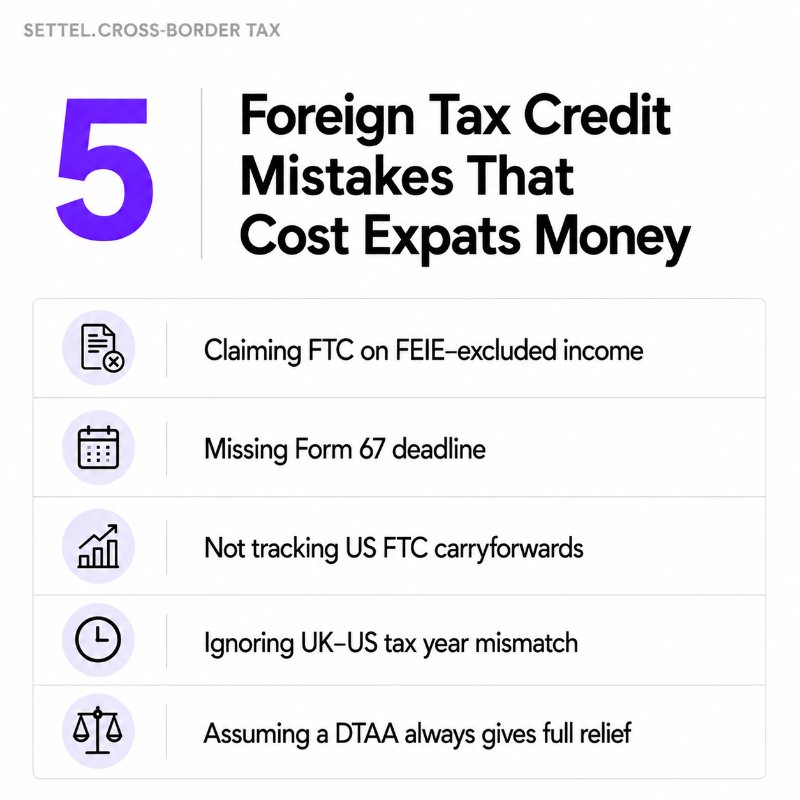
Even seasoned expats stumble on foreign tax credits, and the mistakes tend to repeat themselves.
| Mistake | Why it costs you |
|---|---|
| Misjudging the limitation formula | Caps your credit based on domestic tax liability - get it wrong and you under-claim |
| Ignoring carryback and carryforward rules | Excess credit goes unused instead of offsetting other tax years |
| Missing filing deadlines or required forms | Delays your claim and may require an amended return to fix |
| Claiming credit for tax not yet paid or accrued | The US allows either a paid or accrued basis, but you must apply it consistently |
| Failing to document foreign tax payments | No proof, no credit - receipts and statements matter |
The limitation formula is simpler than it sounds: your credit is capped at (foreign-source taxable income ÷ total taxable income) × your total US tax liability (IRS - How To Figure the Credit). Calculate this before you file - it tells you exactly how much credit you can use this year.
Carryback and carryforward rules matter most when your foreign tax exceeds that limit. Excess credit can be carried back one year - which generally requires an amended return - or forward up to ten. Credit is grouped into "baskets" (general category, passive category, and GILTI-related income as a separate category), and carryforward credit only works within the basket it was earned in. A passive-income credit can't offset general-category tax the following year, and GILTI-category credit can't be carried back or forward at all (IRS Topic 856).
The thing that comes up most when people start mapping their own position out is the basket rule. Almost everyone assumes unused credit just rolls over, full stop - until they discover their passive credit can't touch general-category tax the following year, and the credit they were counting on isn't there. I built basket separation into how Settel tracks carryforward for exactly this reason. It's the detail that costs people the most money, and it's usually the one nobody mentions until it's too late to fix.
Two genuine US legislative changes affect the 2026 picture. First, P.L. 119-21 adds a $6,000 deduction for taxpayers aged 65 or over, which must be excluded from taxable income when computing the foreign tax credit limitation - in effect for tax years 2025 through 2028. Second, the same law disallows 10% of foreign tax credit on certain income excluded from gross income because of a GILTI-related (section 951A) inclusion, effective for amounts after 28 June 2025 (IRS Publication 514 (2025)). This second change is technical and mainly relevant if you hold a controlling stake in a foreign company - it doesn't affect the standard FEIE-versus-credit decision most expats are weighing.
Schedule K-3 matters too. If you hold a stake in a foreign partnership or S-corp, you'll get more detailed reporting on foreign tax paid. A missing or late K-3 doesn't forfeit your credit outright, but it delays your claim and often means filing an amended return once the form arrives.
The interaction between the Foreign Tax Credit and the Foreign Earned Income Exclusion is longstanding, not new for 2026: you cannot claim a foreign tax credit on income you've already excluded under the FEIE (IRS Topic 856). As a starting heuristic: if your foreign tax rate is higher than your US rate, the credit usually outperforms the exclusion, since you'd otherwise be wasting tax you've already paid. If your foreign tax rate is lower, the exclusion often wins. This is a rule of thumb, not a formula - your actual income level, filing status, and which basket the income falls into can change the answer, so it's worth running both ways before you file.
Comparing foreign tax credit regimes: US, UK, India, and UAE
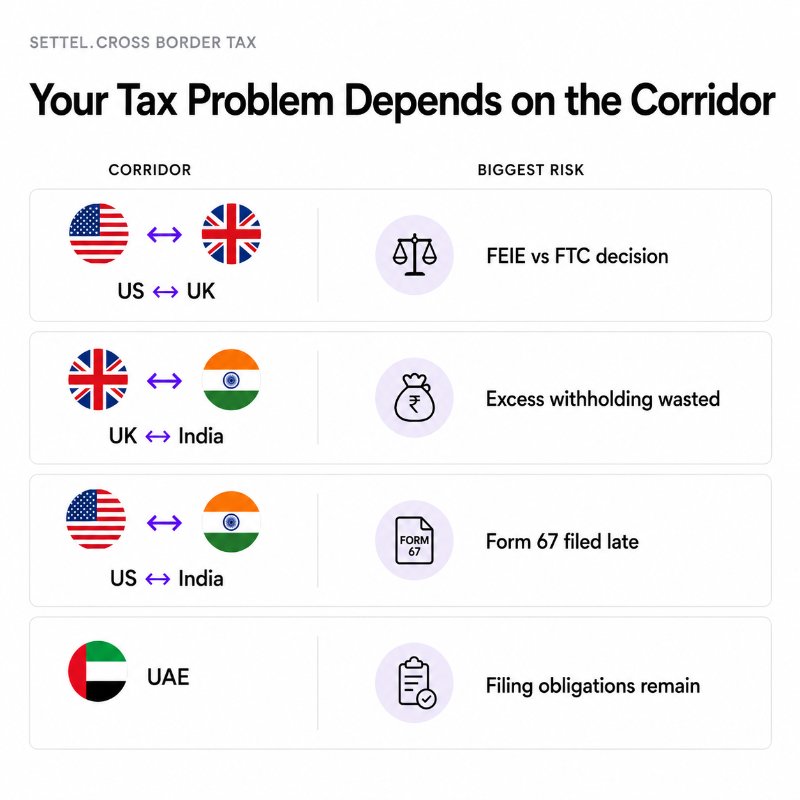
Each country handles foreign tax credit differently. Knowing the differences is what lets you claim correctly instead of guessing.
| Country | Eligibility | Credit period | Calculation method | Relief mechanism | Treaty impact |
|---|---|---|---|---|---|
| US | Citizens and residents with foreign income | Carry back 1 year, forward 10 years (GILTI category excluded) | Dollar-for-dollar up to limitation formula | Form 1116 or simplified method | DTAs can limit or enhance credit |
| UK | Residents taxed on foreign income | Same tax year only | Offset against UK tax on same income | Self-assessment claim (HS263) | Treaty relief often required |
| India | Residents with foreign income | Same financial year only | Lower of foreign tax paid or Indian tax due | Form 67 and tax return filing | DTAAs specify credit methodology |
| UAE | Not applicable | N/A | No personal income tax | N/A | UAE residents still taxed in source country |
The UK's Foreign Income and Gains (FIG) regime is a residence-based exemption, introduced from 6 April 2025, that gives qualifying newcomers full relief - not a partial credit - on foreign income and gains for up to four consecutive tax years, replacing the old indefinite remittance basis (GOV.UK — 4-year FIG regime).
Qualifying individuals get up to four years of relief, provided they weren't UK tax resident in any of the previous ten consecutive tax years. Claiming it means losing your personal allowance and Capital Gains Tax annual exemption for that year, so it isn't automatically the better option if you also have meaningful UK-source income - run the comparison both ways. Once the four years end, you're taxed on worldwide income like any other UK resident.
The UAE presents a different case entirely. With no personal income tax, UAE residents don't claim foreign tax credit domestically — there's nothing to offset against. The UAE does levy 9% corporate tax on business profits above AED 375,000, but that's separate from personal taxation and generally doesn't apply to individuals unless they're running a business with UAE turnover over AED 1 million a year (UAE Ministry of Finance). A UAE resident earning in the UK, US, or India still owes tax there on income earned there.
Double taxation agreements fundamentally shape how credit works, and they can restrict as well as protect. An India-UK DTAA, for instance, sets out specific methodology for crediting Indian tax against UK liability on the same income — read the wrong clause and you'll either under-claim or claim something you're not entitled to. Before claiming any credit, check the applicable DTAA between your country of residence and the country where you earned the income.
Treaties add complexity, but the flexibility is narrower than it's often described. They don't let you simply choose which country taxes you - taxing rights are assigned by income type and residency. Some limited flexibility exists through resourcing-of-income elections in certain US treaties, which let you treat US-source income as foreign-source for credit purposes in narrow, defined circumstances (IRS - Foreign Tax Credit: Special Issues). This is a targeted mechanism, not a free choice - getting it right requires reading the specific treaty article that applies to your income type.
Practical strategies for expats to maximise their tax credits in 2026
Knowing the rules is one thing. Applying them is another. Here's how that plays out for a real expat.
Sarah's situation: a Tier 2 example. Sarah is a US citizen who's lived in the UK for two years. She still holds a US brokerage account paying dividends, and in the most recent tax year she paid $15,000 in UK tax on $100,000 of income. Her US tax liability on that same income works out to $12,000. Without carryforward, the $3,000 difference between what she paid the UK and what she owed the US would simply be lost.
With proper planning, it isn't:
| Scenario | Foreign tax paid | US tax due | Credit used | Excess credit | Outcome |
|---|---|---|---|---|---|
| Without carryforward | $15,000 | $12,000 | $12,000 | $3,000 lost | Pays $0 US tax, loses the excess |
| With carryforward | $15,000 | $12,000 | $12,000 | $3,000 carried forward | Pays $0 US tax, banks the excess |
| Following year | $0 | $10,000 | $3,000 from prior year | $0 | Pays $3,000 US tax instead of $10,000 |
That's the shareable number here: a one-off planning decision saves Sarah $3,000 in tax the following year, just by not letting unused credit expire - and that credit has to sit in the same basket to be usable.
Track every foreign tax payment with receipts, bank statements, and official tax documents as they happen, not at filing time. Understand the limitation formula and run the calculation before you file. File on time, since late filing can complicate carryback options. Use carryback to amend prior returns where it makes sense, and carry forward unused credit deliberately rather than letting it sit unused.
Documentation is where most expats lose credit they're entitled to. HMRC and the IRS both require proof: official tax receipts from the foreign government, bank statements showing the payment, employer withholding statements, foreign tax return copies, and currency conversion records using the exchange rate in effect on the date you paid the foreign tax (IRS Instructions for Form 1116). One condition people miss: the foreign tax has to be a legal and actual liability you genuinely owed, not a voluntary payment - pay more than you legally owed and the excess won't qualify for credit (IRS Publication 514). Keep all of it - reconstructing it later from memory is how thousands get lost.
Review the DTAA or DTA between your country of residence and your income source country before you claim anything. Where you hold assets across more than one of these corridors - UK pension, Indian mutual funds, US brokerage - modelling the credit and timing decisions together, rather than country by country, is usually what reveals the carryforward opportunity in the first place.
Simplify your expat tax strategy with Settel
Settel tracks your foreign tax position the way I wished something had when I was juggling Kuwait, India, and the UK myself - by jurisdiction, by basket, by what's about to expire. The Smart Tax Engine pulls your residency status, income sources, and applicable DTAs into one place and tells you what you can actually claim, not just what the rules say in theory. [Start the current Settel trial → app.settel.io]
This isn't a one-person job to get fully right, and at some point you'll want an accountant to actually file. What Settel does is get you to that conversation knowing your numbers — your residency position, your carryforward, your filing deadlines — instead of walking in guessing. Settel AI, coming soon, will help connect those numbers across all your jurisdictions automatically. Get your position straight first: app.settel.io.
Informational only - not financial advice. Settel is a tracking and calculation tool. Always consult a qualified tax adviser for advice specific to your situation.
FAQ
What types of income qualify for foreign tax credits?
Eligible income generally includes foreign employment wages, dividends, interest, rental income, and capital gains that are also taxed in your country of residence. Foreign tax credit applies across these categories depending on local tax treaties, but only to foreign tax that's a legal liability you've actually paid or accrued — not estimated. Always check your specific DTA or DTAA to confirm which income categories qualify, since some treaties exclude certain types entirely.
How do double taxation agreements affect foreign tax credits?
Double taxation agreements set the rules that prevent the same income being taxed twice, but they often restrict the credit you can claim or exclude certain income from eligibility altogether. A treaty might give one country exclusive taxing rights on pension income, meaning you can't claim a credit for it in your country of residence. Understanding your applicable DTAs before filing is essential to avoid claiming credit you're not entitled to.
Can I use foreign tax credit I didn't use this year, next year?
Yes — you get one year back and ten years forward, but only within the same basket it was earned in. People assume any unused credit just carries over cleanly; it doesn't, and GILTI-related credit can't carry at all. Track it by category from day one or you'll lose the most useful part of it.
Should I use FEIE or claim the credit instead?
You can't do both on the same income - that's been true for years, it's not a 2026 change. If your foreign tax rate is higher than your US rate, the credit usually wins; if it's lower, the exclusion usually does. Run both ways with your real numbers rather than copying what you did last year.
Do I need to file an Indian income tax return to claim foreign tax credit in India?
Yes - claiming foreign tax credit in India requires filing Form 67 along with your Indian income tax return, by the end of the relevant assessment year, and relief is calculated as the lower of the foreign tax paid or the Indian tax due. Missing the deadline puts your claim at risk, though Indian tribunals and at least one High Court have held that late Form 67 filing is procedural rather than mandatory - this isn't a guarantee in practice, so filing on time remains the safer approach.
Is there a tool that tracks foreign tax credit across multiple countries?
Settel's Smart Tax Engine is built for exactly this — tracking income, residency, and foreign tax credit position across the US, UK, India, and UAE in one dashboard rather than four separate systems. For expats managing more than one corridor, this kind of cross-border view is usually what surfaces unused or expiring credit before it's too late to use it. Settel's expat wealth and tax tracking platform is built specifically for this Three-Country Problem.
Recommended
- Expat Asset Protection: Strategies for 2026 | Settel Blog | Settel
- Global Tax Reporting: Avoiding Penalties in 2026 | Settel Blog | Settel
- Types of Global Tax Treaties: An Expat's Guide | Settel Blog | Settel
- Settel: Wealth Management & Tax for Expats in US, UK, UAE, India