
.14 min read
Tax rules change frequently. All examples assume current rules at the time of writing and may not apply to your specific facts or future tax years. The scenarios below are composites for illustration - similar fact patterns can produce different outcomes depending on individual circumstances and timing. Always consult a qualified tax professional for advice specific to your situation.
Most expat tax problems aren't double taxation. They're triple taxation - or the expensive paperwork you needed to prevent it.
If you earn income in one country, live in another, and still have obligations in a third through citizenship, property, or a pension account you haven't touched in years, you don't have an expat tax problem. You have three of them, running simultaneously, governed by rules that were never designed to talk to each other. I built Settel because I lived this. Moving between Kuwait, India, and the UK across a corporate career, I kept arriving at the same moment: sitting in front of an accountant who understood one jurisdiction very well, and mine not quite well enough. This post explains how multi-country expat taxation actually works across the UK, US, India, and UAE corridors - how the rules interact, how the sequencing of foreign tax credits determines whether you're double-taxed, and what you can do about it. It is not a full technical guide to any single jurisdiction - each corridor has its own dedicated Settel explainer. This is about what happens when three of them are active at the same time.
TL;DR - The Three-Country Problem in four sentences
I coined this term because I needed a name for something that kept happening to people around me - and to me. You earn in one country, live in a second, and still owe in a third through citizenship, property, or a residency that technically ended two years ago. Standard expat tax tools fail here because they're built for one jurisdiction, one currency, one tax year, one residency status - and the Three-Country Problem breaks all four at once. In a three-country situation, you pay tax first in the source country, then in your country of residence, then apply any third-country obligation using foreign tax credits in sequence. Getting the sequencing wrong - or missing a credit entirely - is how avoidable double taxation actually happens. Most people get this wrong. Not because they're careless. Because nobody told them the sequence existed.
Key principles of three-country expat taxation:
Always identify income source first, then your country of residency, then any special obligations such as citizenship or property.
Apply relevant tax treaties in pairs, one bilateral relationship at a time - there is no trilateral agreement.
Calculate and apply foreign tax credits sequentially, not simultaneously - credits from Country A reduce liability in Country B, and the outcome in Country B may then affect Country C.
Treaty relief must be actively claimed with correct documentation. It is never applied automatically.
Why Three-Country Expat Taxation Breaks Standard Logic
Two Countries vs Three: What Really Changes for Global Income
The jump from two active jurisdictions to three is not a 50% increase in complexity. It is closer to a tripling - because complexity comes from interactions, not from individual rules.
| One country | Two countries | Three countries | |
|---|---|---|---|
| Tax codes to understand | 1 | 2 | 3 |
| Double Taxation Agreements | 0 | 1 | 3 (A-B, A-C, B-C) |
| Foreign tax credit sequences | 0 | 1 | Nested: credits from A flow through B before reaching C |
| Tax years in play | 1 | 2 (may not align) | 3 (UK April–March, India April–March, US January–December) |
| Currencies to convert | 1 | 2 | 3, at potentially different rates for each reporting requirement |
The three-country version introduces what you might call a sequencing problem: which country taxes first, which credits apply where, and how misaligned tax years and exchange rates distort the final number. A USD 10,000 dividend received in November 2025 is reported three different ways - in the US at the calendar-year exchange rate, in the UK at the rate applicable when received or at the annual average (depending on HMRC's approved method), and potentially in India at yet another rate. The same income, three different figures, all technically correct.
The Four Hidden Assumptions Most Expat Tax Tools Make
Every standard tax calculator, and most single-country advisers, operates on four assumptions. The Three-Country Problem invalidates all four simultaneously.
One jurisdiction determines your rules. In reality, each income type may be taxable in multiple jurisdictions, with DTAs determining priority - not eliminating obligation.
One currency for all transactions. In reality, you may receive income in AED, report it in GBP, and also file in USD - with different exchange rate methods required by each authority.
One tax year tells the complete story. In reality, the UK tax year runs April to April, India's runs April to April (offset by one day), and the US uses the calendar year. A move in October creates partial-year obligations in three different reporting periods simultaneously.
One residency status applies consistently. In reality, you can be UK tax resident, US-obligated by citizenship, and an Indian NRI - all at the same time, each with different worldwide income implications.
In summary: three active tax jurisdictions do not just add rules - they multiply interactions. The sequencing of DTAs and foreign tax credits is where most expat tax errors originate, and it is the piece that standard tools cannot handle.
In fifteen years working across consulting, product, and financial services - and across three countries - I never once met someone who had deliberately set up a three-country tax problem. What I did meet, repeatedly, was people who had done everything sensibly: taken a good job abroad, kept a property at home, left a pension account where it was. They arrived at the three-country problem by accumulation, not by choice. The errors I see in Settel user data follow exactly the same pattern: not recklessness, but reasonable decisions made without a full picture of how they'd interact.
In summary: three active tax jurisdictions do not just add rules - they multiply interactions. The sequencing of DTAs and foreign tax credits is where most expat tax errors originate, and it is the piece that standard tools cannot handle.
Framework: Diagnose Your Multi-Country Expat Tax Problem
The Earn–Live–Owe Checklist for Expats with Global Income
Before you can address a three-country situation, you need to map it. Work through each dimension:
Earn - where does each income type originate?
- Where is each income stream sourced? (Employment, rental, dividends, freelance, pension)
- Is tax withheld at source in that country?
- Which DTAs apply between the source country and your country of residence?
- Is there a reduced withholding rate available - and have you filed the paperwork to claim it?
Live - which residency tests could you trigger this year?
- How many days have you spent in each country this tax year?
- What ties do you hold in each country (family, accommodation, work, prior years)?
- Have you actively obtained a tax residency certificate where needed (UAE)?
- Could a partial-year move create split-year treatment or dual residency in any jurisdiction?
Owe - what obligations persist regardless of where you live now?
- Do you hold US citizenship? (Automatic worldwide filing obligation)
- Do you own property generating income in a prior home country?
- Do you have pension, EPF, or retirement accounts from a previous jurisdiction?
- Have you been resident in a country within the last three years in ways that could still affect your current year's tests?
Your Three-Country Diagnostic Matrix
Use the table below to identify whether you have three active jurisdictions:
| UK | US | India | UAE | |
|---|---|---|---|---|
| Earn - income sourced here | ☐ | ☐ | ☐ | ☐ |
| Live - tax resident here | ☐ | ☐ | ☐ | ☐ |
| Owe - ongoing obligation here | ☐ | ☐ | ☐ | ☐ |
If you have ticks in three or more different columns, you have a Three-Country Problem. If any single column has ticks in two or three rows - for example, you both earn income in India and have an ongoing NRI filing obligation there - the complexity within that corridor is already layered before you add the other two countries.
How to Sequence Multi-Country Tax Rules Across Three Jurisdictions
Once you have mapped your dimensions, the next step is understanding the order in which the rules must be applied. Getting the sequence wrong is how double taxation actually happens - not through ignorance of individual rules, but through applying them in the wrong order.
The general sequence:
Identify source-country taxation. Which country is the income sourced in? Does it withhold tax? At what rate - default or reduced treaty rate? Have you filed the correct form to claim the treaty rate (e.g. W-8BEN for US withholding)?
Identify your country of residence and apply domestic rules. Your residence country typically taxes worldwide income. Report all income streams and apply domestic rates.
Apply each relevant DTA bilaterally. For each income type, which DTA determines primary taxing rights? Does it relieve the source-country withholding or credit it?
Calculate foreign tax credits in order. Credits from Country A reduce liability in Country B. If Country B is not your only other obligation, the remaining liability in Country B may then be creditable in Country C. The credits must be computed layer by layer - not simultaneously.
A worked example: Indian rental income for a UK-resident NRI expat
An NRI receives ₹150,000 per month in rent from a Mumbai flat (approximately £12,000 per year at a representative GBP/INR rate). Here is what happens at each step:
| Step | What happens | Approximate figure |
|---|---|---|
| India withholds TDS at source | 30% under Section 195 plus surcharge/cess (commonly 31.2% total) | ~£3,744 withheld |
| UK requires worldwide income reporting | NRI reports £12,000 on UK Self Assessment | - |
| UK income tax on £12,000 rental at higher rate (40%) | Based on net rental profit | ~£3,840 UK liability |
| Foreign tax credit for Indian TDS paid | Credit of £3,744 against UK liability | - |
| Net UK tax to pay | £3,840 minus £3,744 credit | ~£96 |
| If credit is missed entirely | Full UK liability, no offset | ~£3,744 overpaid |
The credit is not applied automatically. The NRI must report the Indian income, report the TDS paid, and claim the credit correctly on the UK return. Miss any step and the same income is taxed twice. (Income Tax India - Section 195; HMRC foreign income and tax relief guidance)
In summary: the Earn–Live–Owe framework identifies your three active jurisdictions. The sequencing rules determine in which order to apply DTAs and credits. Both steps are necessary - the framework without the sequencing just tells you how many problems you have, not how to resolve them.
Real Three-Country Expat Tax Scenarios
Scenario 1 - UK–UAE–India Expat: Vikram
The setup: Vikram is a senior finance professional who relocates from London to Dubai for work in April 2026. His spouse and two children remain in London for school continuity. He keeps the London flat and rents it out. His UAE salary is AED 600,000 (approximately £130,000 at a representative rate). He visits the UK for around 60 days during the 2026/27 tax year.
His three countries: UAE (where he works, 300+ days), UK (family, property, rental income), India (EPF account, parents' property).
The SRT tie-count problem for UK-UAE expats:
Vikram assumes that 300+ days in the UAE and only 60 in the UK means he is UAE-resident only. Under the UK Statutory Residence Test, he is likely to hold at minimum two ties: a family tie (spouse and children in the UK for more than 91 days) and an accommodation tie (the London flat is available to him). His outcome at 60 days depends on his prior UK residency history and the full SRT matrix - but holding two ties creates genuine UK residency risk even at a relatively low day count.
| Scenario | UK days | UK ties | Likely UK residency outcome |
|---|---|---|---|
| Vikram's assumption | 60 | 0 | Non-resident |
| Realistic position | 60 | 2 (family + accommodation) | Resident risk - check prior-year residency against RDR3 |
| One extra work trip | 70 | 2+ (work tie triggered if 40+ UK working days) | Resident - additional tie triggered |
For a full breakdown of the SRT sufficient-ties test and how prior UK residency affects thresholds: [UK Statutory Residence Test for expats with global income - Settel guide].
What UK residency means for the numbers (2025/26 rates):
| UAE resident only | UK tax resident | |
|---|---|---|
| UAE salary (~£130,000) | No UK tax | UK income tax applies |
| Personal allowance | N/A | £0 (tapered to nil above £125,140 at this income level) |
| Higher-rate tax: 40% on £37,700 | - | ~£15,080 |
| Additional-rate tax: 45% on income above £125,140 | - | ~£2,223 |
| Approximate UK tax exposure on UAE salary | £0 | ~£17,303 |
| London rental income (£18,000/year) | 20% NRLS withholding, then self-assessment | Taxed at marginal rate (40% or 45%) |
These figures are illustrative and rounded. Actual liability depends on full circumstances, allowances, and deductions. At £130,000, the personal allowance is tapered to £0 (reduced by £1 for every £2 above £100,000 - fully withdrawn at £125,140). (HMRC income tax rates and allowances 2025/26; House of Commons Library - Direct taxes 2025/26)
The move date matters enormously:
Had Vikram structured his departure to start on 6 April 2026 (the first day of the UK tax year) rather than at any point mid-year, he would have the clearest possible basis for split-year treatment from the outset. A move in late March rather than April can expose an entire year's non-UK income to UK tax unnecessarily.
| Move timing | 2025/26 tax year | 2026/27 tax year |
|---|---|---|
| Moves 28 March 2026 | UK resident for most of the year - UAE income potentially in scope | Non-resident from April 2026 if SRT conditions met |
| Moves 6 April 2026 | Full UK resident 2025/26 - UAE income taxed all year | Split-year treatment potentially available from day one |
| Moves 6 April 2026 but keeps 2 UK ties | Full UK resident 2025/26 | Residency risk continues in 2026/27 - ties still count |
The India dimension: Vikram's EPF account and the rental income from his parents' property in India represent a third filing obligation that most advisers in either the UK or UAE would not surface unprompted. For detailed NRI treatment of Indian EPF and property income: [India NRI tax guide for expats - Settel guide].
What Settel surfaces three months before year-end: UK day count: 55 days logged. Active ties: 2 flagged (family, accommodation). Residency alert: planned December visit would bring day count to 65 - review before booking. UAE salary tax exposure if UK resident: ~£17,303. Action flagged: consult adviser before travel.
Scenario 2 - US Citizen in Portugal with Global Clients: Sarah
The setup: Sarah is a US citizen and tech consultant who moved to Portugal on a D7 visa in January 2025. Her clients are in the US (60% of income), the UK (30%), and India (10%). Total consulting income: approximately $180,000 for the year.
Her three countries: Portugal (residency), US (citizenship - automatic filing obligation), UK and India (income sources with potential source-country withholding).
The US filing obligation for expats living abroad:
Sarah must file Form 1040 on her worldwide income for the 2025 tax year regardless of where she lives. The Foreign Earned Income Exclusion (FEIE) can shelter up to $130,000 of foreign earned income for 2025. (IRS FEIE guidance)
| Without FEIE | With FEIE (2025, $130,000 limit) | |
|---|---|---|
| Total consulting income | $180,000 | $180,000 |
| FEIE exclusion | $0 | ($130,000) |
| US taxable income (illustrative, pre-deductions) | $180,000 | $50,000 |
| Approximate US federal income tax (simplified) | ~$37,000+ | ~$6,000–8,000 |
| Note | - | Self-employment tax still applies on net earnings; FEIE and FTC cannot generally both be claimed on the same income |
These are approximate illustrative figures. Actual US tax depends on filing status, deductions, self-employment tax treatment, and the interaction of FEIE with the Foreign Tax Credit. A US-qualified adviser is essential.
If her foreign financial accounts exceed $10,000 in aggregate at any point during 2025, she must file an FBAR (FinCEN Form 114), due 15 April 2026 with an automatic extension to 15 October 2026 - no separate request required. (IRS FBAR guidance)
The Portugal tax position:
Portugal's NHR regime closed to new applicants from 1 January 2024 and has been replaced by the IFICI regime (Tax Incentive for Scientific Research and Innovation). (International Bar Association - IFICI overview)
| Under IFICI (if eligible) | Standard Portuguese progressive rate | |
|---|---|---|
| Qualifying Portuguese-source income (flat rate) | 20% | Up to 48% |
| Foreign-source consulting income | Broadly exempt | Taxable at progressive rates |
| Foreign-source passive income | Broadly exempt (exceptions apply) | Taxable |
| Pension income | Not favoured - taxed at progressive rates | Taxable at progressive rates |
IFICI eligibility is restricted to highly qualified professionals in approved sectors: scientific research, technology innovation, education, and certain roles at certified startups and qualifying companies. A general tech consultant on a D7 visa does not automatically qualify. Whether Sarah is eligible depends on the precise nature of her work and its registration with the relevant Portuguese authority. The difference between qualifying and not qualifying is the difference between a 20% flat rate and progressive rates up to 48% - on the same income.
The UK source income question - whether the UK can tax her consulting fees from UK clients - depends on where the services are physically performed, her contract structure, and the provisions of the UK-Portugal DTA. This is a specialist question that a standard calculator cannot answer. For a detailed treatment: [Source vs residence taxation for expat service income - Settel guide].
Scenario 3 - UK Resident with India and US Investments: Priya
The setup: Priya is a software engineer who moved from Mumbai to London in 2021. She is UK tax resident under the SRT and an NRI under Indian law. She earns a UK salary of £75,000, receives rental income from a Mumbai flat (₹150,000/month, approximately £12,000/year), and holds a US stock portfolio paying approximately $5,000 in annual dividends.
Her three countries: UK (residency, employment), India (rental income, NRI filing obligation), US (dividend income, withholding at source).
UK salary - the baseline:
| Band | Taxable income | Tax rate | Tax |
|---|---|---|---|
| Personal allowance | £12,570 | 0% | £0 |
| Basic rate | £37,700 | 20% | £7,540 |
| Higher rate (remainder) | £24,730 | 40% | £9,892 |
| Total UK income tax on salary | £75,000 | - | ~£17,432 |
(HMRC income tax rates 2025/26)
Indian rental income - the cost of missing the foreign tax credit:
| Getting it right | Missing the credit | |
|---|---|---|
| Indian rental income (approx. GBP equivalent) | £12,000 | £12,000 |
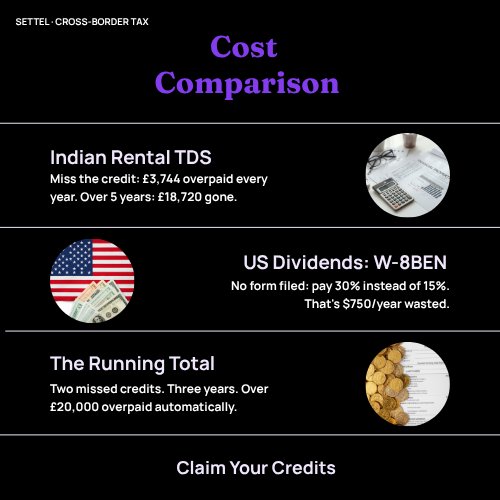
| TDS withheld in India at 30% + surcharge/cess | ~£3,744 | ~£3,744 |
| UK income tax on rental income at 40% | ~£3,840 | ~£3,840 |
| Foreign tax credit for Indian TDS claimed on UK return | (£3,744) | £0 |
| Net UK tax to pay | ~£96 | ~£3,840 |
| Annual overpayment if credit missed | - | ~£3,744 |
(Income Tax India - Section 195)
US dividends - the cost of not filing the W-8BEN:
| W-8BEN on file (treaty rate) | No W-8BEN (default rate) | |
|---|---|---|
| US dividends received annually | $5,000 | $5,000 |
| US withholding rate | 15% (Article 10, US-UK DTA) | 30% (default under IRC §1441) |
| US tax withheld | $750 | $1,500 |
| Annual overpayment | - | $750 |
| Over three years without filing W-8BEN | - | $2,250 overpaid |
(US-UK Double Taxation Convention - Article 10)
The W-8BEN must be filed with the US broker and renewed periodically. It is a single form. Not filing it is among the most avoidable expat tax errors for UK residents holding US equities.
What Priya must also declare in the UK: Her worldwide income - including the Mumbai rental and the US dividends - must be reported on her UK Self Assessment return. The foreign tax credit for Indian TDS and the treaty-rate credit for US withholding must both be actively claimed. Neither is applied automatically.
In summary: across all three scenarios, the pattern is the same. The rules exist to prevent double taxation. But they only work if you know they apply, file the right paperwork, and claim the credits in the right order. The cost of not doing so - in Priya's case alone - runs to thousands of pounds annually.
Residency Tests Expats Need to Know
This section is a quick reference only. Each test has a dedicated Settel guide with full tie tables, day-count grids, and worked examples linked below.
UK Statutory Residence Test for Expats - In Brief
The SRT determines UK residency for each tax year separately. The sequence:
- Automatic overseas tests first: Fewer than 16 UK days (if UK resident in any of the prior 3 years), or fewer than 46 days (if not UK resident in any of the prior 3 years), or full-time overseas work meeting specific criteria → automatically non-resident.
- Automatic UK tests second: 183+ UK days, or only home is in the UK, or full-time UK work → automatically resident.
- Sufficient ties test if neither applies: Your number of UK ties (family, accommodation, work, 90-day, country) is matched against your day count and prior-year residency to determine the outcome. The same day count can produce different outcomes depending on which and how many ties you hold.
Split-year treatment can limit UK tax to the resident portion of a year in which you arrive in or depart from the UK. It must be claimed - it does not apply automatically.
Full guide with tie tables, day-count grids, and split-year worked examples: [UK Statutory Residence Test for globally mobile expats - Settel guide] (HMRC RDR3 Statutory Residence Test guidance)
US Expat Taxation - Headline Rules
Non-citizens: The substantial presence test uses a three-year rolling formula (all days in the current year, plus one-third of the prior year, plus one-sixth of the year before - total 183 or more). Treaty tie-breakers can override domestic residency determinations.
US citizens: Citizenship-based taxation means worldwide income is taxable regardless of where you live or how long you've been away. The FEIE ($130,000 for 2025), Foreign Tax Credit, FBAR reporting (accounts exceeding $10,000 aggregate, due 15 April with automatic extension to 15 October), and FATCA Form 8938 requirements all remain in force. This is the mechanism that most commonly creates the third leg of a three-country expat tax problem.
India NRI Residency - Headline Rules
Primary rule: Fewer than 182 days in India in the financial year (April – March) → NRI status. (Income Tax India - residential status rules)
High-income rule: Indian citizens and Persons of Indian Origin visiting India whose total Indian income (excluding foreign sources) exceeds ₹15 lakh may be classified as RNOR (Resident but Not Ordinarily Resident) if they spend 120 or more days in India and have spent 365+ days there in the preceding four years. RNOR status means Indian-source income is taxable in India, but foreign income generally is not.
From April 2026: The Income Tax Bill 2025 removes the employment-abroad exemption for freelancers and self-employed individuals, tightening residency rules for this group specifically.
Full guide: [India NRI and RNOR residency rules for cross-border professionals - Settel guide]
UAE Tax Residency - Headline Rule
The UAE has no personal income tax. UAE tax residency matters primarily for claiming treaty benefits in other jurisdictions. For treaty purposes, the UAE Federal Tax Authority typically requires at least 183 days of physical presence in the relevant 12-month period to issue a Tax Residency Certificate. The certificate must be actively applied for - it is not issued automatically on the basis of physical presence.
In summary: all four residency tests - UK SRT, US substantial presence, India 182/120-day rules, and UAE TRC - require active management throughout the year. None of them resolves itself at filing time if the underlying facts have been ignored.
The Real Cost of Getting Three Countries Wrong
Professional Fees: The False Economy of Under-Resourced Advice
A UK self-assessment return for straightforward employment income: £300–800. A coordinated three-country filing - UK, US, and India, with foreign tax credit reconciliation across all three - is a different category of engagement. Based on Settel's conversations with cross-border practitioners, coordinated three-country work typically runs into the low thousands annually. These are editorial estimates; fees vary significantly by complexity, income level, and adviser.
The comparison that matters: three years of uncoordinated filings producing a cumulative underpayment (unreported foreign rental income, missed treaty claims, incorrect residency determination) triggering an HMRC enquiry, with interest and penalties added to the back-tax - versus the cost of a qualified adviser from year one. If you're already in this position, here's how to fix multi-country errors before HMRC does.
Time Cost: What Year-Round Management Actually Requires
Gathering documents across three jurisdictions. Converting currencies at the rate each authority requires. Tracking which forms are due where and when. Checking whether your day count is approaching a threshold in a country you only visit occasionally. Verifying that your W-8BEN is still on file. Confirming your UAE tax residency certificate is current before you need it.
This is not a once-a-year exercise at filing time. The decisions that affect your expat tax position happen throughout the year - a work trip, a property visit, a dividend reinvestment. Managing them reactively, in April, is how avoidable mistakes accumulate.
Opportunity Cost: What Goes Unclaimed in Multi-Country Tax Situations
Example 1- US withholding: $20,000 per year in US dividends at 30% default withholding rather than 15% treaty rate. Annual overpayment: $3,000. Over three years without a W-8BEN on file: $9,000 paid unnecessarily to the IRS.
Example 2- Indian rental credit: £12,000/year in rental income with TDS of ~£3,744 withheld. If the foreign tax credit is never claimed on the UK return, £3,744 per year is double-taxed. Over five years: £18,720 overpaid.
Example 3- Move date and split-year treatment: A £50,000 bonus paid in March 2026 to someone who moved abroad in April 2026 is taxable in the UK as a UK-resident receipt. The same bonus paid in April 2026, after split-year treatment takes effect, may be outside the UK charge entirely - depending on the precise split-year rules and circumstances. The tax on that one payment at the 45% additional rate: up to £22,500. The date of the payment matters as much as the date of the move.
In summary: the cost of getting three countries wrong is not just the professional fees to correct it. It is the back-tax, the interest, the penalties, and - most significantly - the years of overpayment that accumulate silently before anyone notices.
How to Act If You Have a Three-Country Problem
Four Concrete Steps to Take This Quarter
Step 1: Map your Earn–Live–Owe dimensions. Use the checklist and matrix above. Identify every income stream by source country, every jurisdiction where you might be tax resident, and every ongoing obligation. Write it down. This is the document your adviser needs - and most people have never created it.
Step 2: Test your current tools. Run your situation through our three-point calculator test: does your current tool ask for your move date, your ties, and your treaty position? If any answer is "no," your numbers are incomplete.
Step 3: Find the right professional. Cross-border expat taxation requires experience in your specific corridor combination, not just "international tax" generally. A UK-India specialist and a UK-US specialist are not interchangeable. When assessing an adviser, ask specifically: have they handled your exact corridor? Can they coordinate with advisers in other jurisdictions? Can they model scenarios - not just file returns?
Step 4: Start tracking year-round. Day counts, tie triggers, filing deadlines, FX movements that shift your effective position. These matter in October, not just at filing time.
Decisions Expats Should Always Model Before Making Them
Some financial decisions look straightforward but have cascading implications across three simultaneous tax systems. These consistently cause the largest avoidable costs:
Moving mid-tax-year vs at year-end: As the Vikram example shows, the timing of a move relative to the UK tax year and split-year eligibility can swing a liability by tens of thousands of pounds. Always model both scenarios before committing to a move date.
Selling a property: Which country taxes the capital gain? Does a DTA shift primary taxing rights? Have exchange rate movements created a gain in one currency that is a loss in another?
Exercising stock options or receiving a bonus: If these straddle a move or a year-end, the taxing jurisdiction may not be the one you assume. The timing of receipt, not just of vesting, often determines which country taxes it.
Changing from employment to contracting: Employment income and self-employment income are treated differently under most DTAs. Your exposure to source-country taxation and social security contributions in multiple jurisdictions may change. Model this before restructuring.
How Settel Fits into the Three-Country Stack
Settel is a cross-border tax and wealth tracking platform that helps expats and global earners model multi-country tax outcomes. It does not provide tax advice or filing services.
What it does is give you the clarity - and the documentation - to work more effectively with the professionals who advise and file.
Specifically, for the Three-Country Problem:
Day-count and tie-risk tracking: Settel monitors your day counts across multiple jurisdictions and flags residency threshold proximity before it becomes a problem. Vikram's scenario is the use case - knowing you're approaching a UK tie trigger in October is useful; finding out in April is not.
FX-normalised income dashboard: All income streams converted to your base currency in real time, with the ability to see what each stream looks like in each reporting currency. The same £12,000 in Mumbai rental income looks different when you're reporting it to HMRC in GBP, to the Indian tax department in INR, and reconciling credits between them.
Multi-jurisdiction compliance calendar: UK Self Assessment (31 January), US FBAR (15 April, auto-extended to 15 October), Indian ITR, UAE TRC renewal - all in one place, with advance reminders.
Scenario modelling: The Scenarios tab lets you model the financial impact of a move, a property sale, a pension withdrawal, or a bonus timing decision before you commit. The "move in March vs April" question is exactly what Settel surfaces.
Settel AI - A feature that will help you understand your full cross-border wealth and tax position in plain language, surfacing optimisation options across jurisdictions.
Here's what Vikram would see in Settel three months before year-end: UK day count: 55 days. Active ties: 2 flagged (family, accommodation). Residency alert: planned December visit would bring day count to 65 - review before booking. UAE salary tax exposure if UK resident: ~£17,303. Action flagged: consult adviser before confirming travel dates.
We don't file your returns. We don't tell you what to do. We show the maths. You know what to do.
Join Settel - We are live!
FAQs
I have income in multiple countries and I live somewhere else - how do I even start?
Start with source, not residency. Work out where each income stream originates and whether tax is being withheld there. Then work out where you're resident and what that country requires you to report. Any third obligation - citizenship, property, old pension accounts - comes last. What most people discover when they do this properly is that they have more active jurisdictions than they thought, and the credits that should be reducing their bill have never been claimed. The Earn–Live–Owe checklist above is the starting point. Do it on paper before you speak to anyone.
Do tax treaties actually prevent double taxation - or just reduce it?
They reduce it, in most cases, if you claim the relief. DTAs allocate primary taxing rights between two countries and specify mechanisms - exemption or credit - for avoiding double taxation on the same income. But they only work in pairs: there is no trilateral agreement covering all three countries at once. With three active jurisdictions, you have three bilateral relationships to manage in sequence, and credits must be applied layer by layer. The treaty does not file the claim for you. A W-8BEN, a foreign tax credit election, a certificate of residence - these are the actions that turn treaty entitlement into actual tax saved.
Can I be domestic tax resident in two countries but treaty-resident in only one?
Yes. Multiple countries can classify you as a domestic tax resident under their own rules simultaneously. DTAs contain tie-breaker provisions - permanent home, centre of vital interests, habitual abode, nationality - that determine which country has treaty-residency for DTA purposes. But treaty residency does not cancel domestic residency in the other country. You may still be required to file returns in both and claim treaty relief in one. This is the technical basis of many three-country situations - domestic residency in two, treaty-residency in one, plus citizenship-based obligations in a third.
What changes practically if I renounce US citizenship?
Renunciation triggers the US exit tax regime, which treats most assets as sold at fair market value on the day before expatriation. Unrealised gains on Indian mutual funds, UK property, and other cross-border assets may all become immediately taxable. For long-term expats with significant multi-country holdings, the exit tax calculation can be substantial and unexpected. This warrants a dedicated conversation with a US-qualified tax adviser before any decision is made. See our dedicated guide: [US citizenship renunciation and exit tax for global professionals - Settel guide].
If you've read this far, you're probably not someone who thinks they have a simple tax situation. You have income in at least two countries. You have a property, or an EPF account, or a US brokerage account, or a family tie that keeps pulling you back somewhere. You're filing something, somewhere - but you're not sure the credits are right, or whether your day count has crossed a threshold you weren't tracking. Settel won't file your returns or give you legal advice. What it will do is show you the full picture across all your jurisdictions, in one place, before your adviser does - so you arrive at that conversation knowing which questions to ask. Start mapping your position at app.settel.io.
Informational only - not financial advice. Settel is a tracking and calculation tool. Always consult a qualified tax professional for advice specific to your situation.