
· 10 min read
You've filed your UK Self Assessment every year. On time, correctly, without fuss. What you probably haven't done is declare the interest sitting in that UAE account you opened three jobs ago, or claim back the Indian withholding tax you've already paid on your mutual fund distributions. Not because you were hiding anything. Because you couldn't see it. When your financial life is spread across three countries, the problem isn't the money - it's that no single tool shows you the whole picture.
I built Settel because I was Priya. Different countries, same blind spots. A dormant account quietly earning interest I wasn't reporting. A tax credit I was entitled to and never claimed. A spreadsheet that told me roughly what I was worth in three currencies but nothing about what I actually owed. The frustrating part wasn't the complexity - it was that the complexity was entirely manageable, if you could just see everything in one place. Most expats can't. Not because the tools don't exist, but because every tool they have was built for someone who only lives in one country.
TL;DR: An expat wealth tracking dashboard is a single view of your global net worth, global income, and tax-relevant data across all the countries and currencies where your financial life sits. For expats, NRIs, and globally mobile professionals managing finances across the UK, India, UAE, or US, building that view is a five-step process: map your cross-border footprint, standardise currencies without losing the audit trail, layer residency and tax tags on each account, reconcile quarterly, and use the consolidated picture to surface treaty credits and optimisation opportunities your single-country tools will never flag.
This guide works through each step using Settel's Cross-Border Wealth Tracking Framework. The tax rules that sit behind each step live in Settel's dedicated corridor guides - linked throughout. This piece is about the data infrastructure that makes those rules actionable.
The Three-Country Problem: Why Standard Finance Apps Fail Expats
The Three-Country Problem is when an expat's income, investments, and tax residency are spread across at least three countries simultaneously - making global tax and wealth tracking genuinely non-trivial with any single-country tool. Learn how multi-country expat taxation actually works"
For expats, NRIs, digital nomads, and globally mobile professionals, the main problem is not earning across borders. It's seeing global income, wealth, and tax in one place.
Something I noticed during my years in corporate banking: the internal systems are excellent at tracking one thing at a time. A single currency, a single jurisdiction, a single product line. That's not a design flaw - it's a deliberate architectural choice that works perfectly well for most retail customers. What it means in practice, though, is that the data infrastructure most people rely on was never built to hold a cross-border life. The bank isn't missing your UAE account. It just has no reason to know it exists.
A UK banking app shows GBP. An Indian fund platform shows INR. A UAE bank account sits dormant, earning interest in AED that isn't visible in either. The problems this creates are practical, not theoretical:
- Hidden accounts. Dormant accounts opened in a previous country of residence accumulate balances and income that don't appear in your current financial picture.
- Inconsistent FX. Converting balances at today's rate for a rough net worth check is fine. Using the wrong rate or date for a tax calculation is a filing error.
- Mismatched residency assumptions. A platform built for UK residents treats all your income as UK income. It cannot model what Indian withholding tax does to your UK liability, or whether a foreign tax credit offsets it.
- Missed treaty relief. Foreign tax credits don't claim themselves. Without a view that tags income by source jurisdiction, it's straightforward to pay tax twice on the same income without realising it.
- Fragmented records. If a tax authority asks you to evidence your foreign asset position two years ago, three separate banking apps and a spreadsheet are not sufficient.
The table below shows what the same financial position looks like across three separate native apps versus a single base-currency view:
| Account | Native app view | Unified GBP view |
|---|---|---|
| UK current account | £18,400 | £18,400 |
| Indian equity mutual funds | ₹12,00,000 | £11,240 (at 106.8 INR/GBP) |
| UAE savings account | AED 45,000 | £9,710 (at 4.63 AED/GBP) |
| Total net worth | Three numbers. Three currencies. No picture. | £39,350 |
Without the unified view, Priya had no sense that her UAE account alone was worth nearly £10,000 - or that it was generating declarable interest income in the UK.
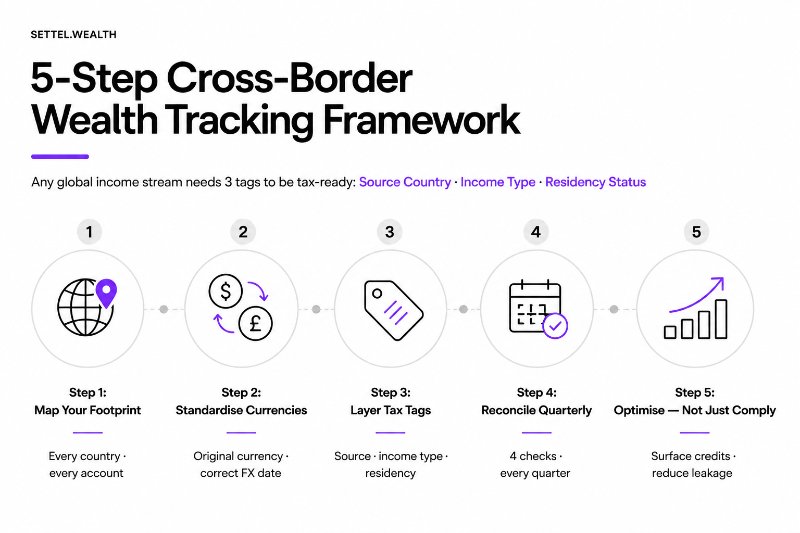
Settel's Cross-Border Wealth Tracking Framework: Five Steps
Any global income stream needs three tags to be tax-ready: source country, income type, and your residency when it arose. The five steps below build the system that makes those tags possible - and useful.
- Map your cross-border footprint and data sources
- Standardise currencies and valuations without losing the audit trail
- Layer residency and tax tags on top of your accounts
- Reconcile and build a repeatable review routine
- Use your consolidated view to optimise - not just comply
Step 1: Map Your Cross-Border Footprint and Data Sources
Before you open a platform or touch a spreadsheet, you need a complete inventory of where your financial life actually sits.
Start with a list of every country where you have - or have ever had - a banking or investment relationship. Include countries you worked in briefly, places you held property, anywhere a pension contribution was made. A former country of residence is the most common source of overlooked accounts.
Then for each jurisdiction, gather:
| Document Type | Where to Find It | Period |
|---|---|---|
| Bank statements (current & savings) | Online banking portal or branch | Last 12 months |
| Investment & brokerage statements | Fund platform or broker portal | Last 12 months |
| Pension / provident fund statements | Employer, EPFO portal, or pension provider | Latest statement |
| Property valuations & mortgage balances | Land registry, lender, or estate agent | Current |
| Rental income records | Tenancy agreements, credited payments | Last 12 months |
| Cryptocurrency transaction history | Exchange download or wallet export | Full history |
| Insurance policies with cash value | Insurer portal or policy documents | Current surrender value |
Collect in original currency. Don't convert at this stage. FX translation comes later, with the correct date-specific rate.
Search your email. A systematic search for terms like "bank statement," "account opening," "NRE account," "provident fund," "401(k)," and "policy document" typically surfaces accounts people have genuinely forgotten. A common find for NRIs: a dormant NRE fixed deposit still rolling over automatically, and a small 401(k) balance from a stint working in the US that was never rolled over or withdrawn.
Step 2: How to Standardise Currencies and Valuations Without Losing Your Audit Trail
The principle: always store original-currency values as the source of record, then layer FX translation on top. Never overwrite raw data with a converted figure.
Why it matters - a concrete example:
Priya's Indian mutual funds are worth ₹12,00,000. She checks the GBP equivalent twice, four weeks apart:
| Date | INR/GBP rate | GBP equivalent | Difference |
|---|---|---|---|
| 1 March 2025 | 108.2 | £11,090 | — |
| 1 April 2025 (tax year end) | 106.8 | £11,240 | +£150 |
Rates are illustrative examples.
That £150 difference is not a gain from the fund itself — it is purely a currency movement. If Priya were to dispose of the funds, the UK capital gains calculation would use the sterling value at acquisition and at disposal, both translated at the correct transaction-date rate. Using the wrong date understates or overstates the gain — which is a filing error, not a rounding issue.
Settel handles FX translation automatically at both valuation and transaction dates, maintaining the original-currency record underneath. You see the GBP (or USD, or INR) view without losing the audit trail a tax authority would need to inspect.
Step 3: Layer Residency and Tax Tags on Top of Your Accounts
Once your accounts are consolidated and currencies are correctly handled, every account needs three attributes:
- Source jurisdiction - where the income is generated (India, UAE, UK, US)
- Income type - employment, investment dividend, capital gain, rental, interest, pension
- Your residency status at the time the income was received
These three tags are what allow your platform to apply the correct tax rules to each income stream - and to surface treaty credits and exemptions you're entitled to claim.
For a UK-resident NRI, the basic tagging looks like this:
| Account | Source jurisdiction | Income type | Residency at receipt |
|---|---|---|---|
| UK salary | United Kingdom | Employment income | UK resident |
| Indian equity mutual fund distributions | India | Investment income (dividend / capital gain) | UK resident |
| UAE savings account interest | UAE | Interest income | UK resident |
From 6 April 2025, UK residents are taxed on the arising basis on worldwide income and gains — which means all three income streams above are potentially declarable in the UK. The previous remittance basis exemption for non-domiciled individuals has been abolished and replaced by the Foreign Income and Gains (FIG) regime. Whether you qualify for FIG four-year relief depends on your prior UK residency history.
This is where the detail lives in the corridor guides. The UK SRT thresholds, FIG conditions, India's RNOR rules, and US citizen obligations are each covered in full. If you're close to a threshold boundary — stop here and follow the relevant guide before configuring your residency status.
→ UK expat tax guide
→ India NRI tax guide
→ US expat tax guide
→ UAE expat tax guide
Settel's Smart Tax Engine applies these rules once your accounts are correctly tagged - calculating residency-aware obligations across your active corridors and flagging applicable treaty credits. The day-count tracker logs your physical presence in real time, so your residency position is visible before the tax year closes, not after.
Step 4: How Often Should Expats Reconcile Global Wealth and Tax Data?
A consolidated global income and net worth dashboard is only as reliable as its last reconciliation. This step turns a one-time setup into a repeatable system.
Quarterly routine - four checks:
- Balance verification. Compare every platform balance against your most recent statement. Mismatches signal a sync failure or a data entry error.
- FX sanity check. Confirm that currency conversions are using current rates, not stale cached values.
- Income tags spot-check. Confirm that any new income received in the quarter — dividend, interest, rental credit — has been correctly tagged by source jurisdiction and type.
- Treaty settings review. If you've received foreign income with withholding tax deducted at source, confirm it's configured for a foreign tax credit claim on your return.
Event-driven triggers - reconcile immediately when:
- You move countries or change residency status
- You start a new employment contract in a different jurisdiction
- You purchase or dispose of property
- You make a large investment disposal (shares, mutual funds, crypto)
- You begin to receive pension income
The evidence pack. Export a PDF snapshot of your consolidated wealth overview each quarter. Store it with your corresponding bank statements and residency day-count log. This is the timestamped record you produce if a tax authority later questions your reported assets or the timing of changes to your financial position.
Priya's reconciliation find - an illustrative example:
During her quarterly check, Priya identifies two items she hadn't logged: AED 820 in interest credited to her UAE account across the quarter, and an Indian mutual fund dividend of ₹9,400. Translated to GBP at the relevant dates, these add approximately £340 to her declarable foreign income for the year. On their own, a small number. But they also unlock a foreign tax credit: India withheld tax on that dividend at source. Priya can claim credit for the Indian tax against her UK liability on the same income — which she had not been doing.
Figures are illustrative example amounts. Your position will depend on your specific income, residency status, and applicable treaty provisions.
Step 5: Use Your Consolidated View to Optimise - Not Just Comply
Once the data is right, a multi-country tax and wealth tracking platform does more than tell you what you owe. It shows you decisions worth making.
Identify under-performing cash across jurisdictions. A UAE savings account generating modest AED interest, taxed in the UK at your marginal rate, may be less efficient than it appears when translated and tax-adjusted. A consolidated view surfaces this in a way that three separate apps never will.
Detect duplicated cash buffers. Many expats maintain emergency reserves in multiple countries simultaneously. Once visible in a single base-currency view, the duplication is often obvious - and the excess can be redeployed after taking advice.
Surface under-claimed treaty relief. The most common optimisation for UK-India corridor holders is the foreign tax credit on Indian dividend withholding. For US citizens abroad, the Foreign Tax Credit on UK or Indian income is frequently under-claimed relative to what the treaty allows. A correctly tagged, reconciled platform makes these gaps visible. Your tax adviser acts on them - rather than spending the first hour of every meeting reconstructing your financial picture. 5 tax and legal strategies for protecting multi-country income in 2026"
The table below maps each corridor to its common tracking gap, the optimisation it surfaces, and the guide to follow:
| Corridor | Common tracking gap | Optimisation to surface | Guide |
|---|---|---|---|
| UK–India | Unclaimed FTC on Indian dividend withholding; unreported Indian interest | Claim credit via SA106 + Form 26AS | India NRI tax guide |
| UK–UAE | Unreported UAE interest income (declarable in UK from 2025-26 on arising basis) | Declare on Self Assessment; no UAE tax to credit | UK expat tax guide |
| UK–US | FBAR / FATCA reporting gaps; FTC vs FEIE election | File FinCEN 114; review FTC election with US-qualified adviser | US expat tax guide |
| India–UAE | Indian tax on worldwide income if RNOR period expires | Confirm residency status; review Indian filing obligations | India NRI tax guide |
| India–US | US worldwide income taxation + Indian filing obligations run in parallel | FBAR, FATCA, and Indian ITR obligations active simultaneously | US expat tax guide |
| US–UAE | US taxes worldwide income regardless of UAE residency | FEIE or FTC election; no UAE tax to offset | US expat tax guide |
Settel AI surfaces these optimisation options directly from your connected account data, identifying unclaimed credits and treaty benefits based on your specific multi-jurisdiction profile.
Priya Revisited: Before and After Tracking Properly
The table below summarises Priya's position before and after building a consolidated cross-border wealth picture. All figures are illustrative example amounts.
| Before | After | |
|---|---|---|
| Known accounts | 2 (UK current, Indian MF) | 3 (+ UAE savings) |
| Total net worth (GBP) | ~£29,640 (UK + India only) | ~£39,350 (all three) |
| Declarable foreign income identified | £0 (nothing flagged) | ~£1,180 (UAE interest + Indian MF dividend, illustrative) |
| Foreign tax credit claimed | £0 | ~£95 (Indian withholding tax credited against UK liability, illustrative) |
| UK tax position | Understated; potential underpayment | Correctly filed; FTC claimed |
| Evidence pack for audit | None | Quarterly PDF snapshots, day-count log, Form 26AS |
All figures are illustrative examples. Your position depends on your specific income levels, residency status, tax rates, and applicable treaty provisions. Always consult a qualified tax professional.
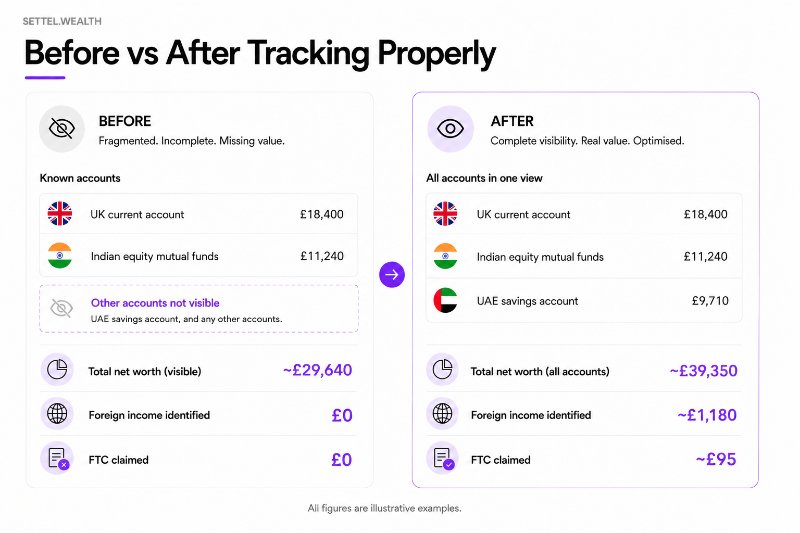
The gap between those two columns is not unusual. It's the predictable result of managing multi-country finances without a multi-country tool.
Implementation Checklist for Expats and Global Income Earners
A practical sequence for getting this done. Work through it once to set up, then use the quarterly routine in Step 4 to maintain it.
Footprint audit
- List every country where you have or have had a banking or investment relationship
- Search email for account opening confirmations, pension statements, and brokerage documents
- Add forgotten or dormant accounts to your inventory
Data gathering
- Collect 12 months of statements for every active account, in original currency
- Download full transaction history for any cryptocurrency holdings
- Note current valuation and outstanding mortgage for any property
Platform setup
- Choose your base currency (typically your country of residence currency)
- Add each account, maintaining original-currency values
- Verify every balance against its corresponding statement
- Tag each account: source jurisdiction, income type, residency status at time of receipt
Residency and tax configuration
- Confirm your residency status in each jurisdiction — follow the relevant corridor guide if you're close to a threshold
- Configure applicable Double Taxation Agreements for your active corridors
- Flag any income streams with foreign withholding tax for treaty credit claims
Ongoing
- Set a quarterly calendar reminder for the four-point reconciliation routine
- Export a PDF wealth snapshot at each quarterly review
- Share read-only platform access with your tax adviser before filing season — not during it
- Reconcile immediately after any country move, large disposal, or new income source
If you have a US obligation:
FBAR, FATCA, and FEIE/FTC considerations run in parallel to everything above and have their own deadlines. Follow the US expat tax guide.
People Also Ask: Expat Wealth Tracking and Global Income
How do expats track global net worth across multiple currencies?
The reliable approach is to store all account values in their original currency and apply FX translation at the correct valuation date - never hard-code a converted figure into your raw data. A multi-currency wealth tracking platform does this automatically, maintaining the original-currency audit trail underneath the base-currency view. For tax purposes, the translation rate that matters is the rate on the specific date of income receipt or asset disposal - not today's rate.
What is the Three-Country Problem in expat taxes?
The Three-Country Problem is when an expat's income, investments, and tax residency are spread across at least three countries simultaneously. A UK-resident NRI with Indian mutual funds and a UAE savings account is a typical example: earning in the UK, investing in India, holding cash in the UAE, with each jurisdiction applying its own rules to income generated in the others. The result is overlapping filing obligations, potential double taxation without treaty relief, and a complete financial picture that no single-country tool can show.
How do I track global income for multi-country tax filing?
Every global income stream needs three attributes to be tax-ready: source country, income type, and your residency status when it arose. Tag each account in your platform accordingly, connect applicable Double Taxation Agreements for your corridors, and run a quarterly reconciliation to catch new income, FX movements, and withholding tax that needs to be claimed as a credit. The corridor guides linked throughout this post cover the specific filing rules for each pairing.
How is a multi-country wealth tracker different from a standard budgeting app?
A standard budgeting or portfolio app is built around a single tax residency and a single base currency. It tracks income and spending but has no concept of source jurisdiction, treaty credits, residency thresholds, or foreign withholding tax. A multi-country tax-aware global wealth tracker like Settel is built around the assumption that income, assets, and tax obligations sit in different countries simultaneously - and that the relationships between those countries (through Double Taxation Agreements, residency tests, and reporting thresholds) are what determine what you owe and where.
Frequently Asked Questions
Which accounts must I include in my expat wealth tracking?
Every account where you hold money or assets across every country where you've lived or worked - including dormant ones. For UK residents, worldwide income is taxable on the arising basis from 2025-26, which means foreign accounts generating interest or dividends are declarable. For US citizens and green card holders, FBAR reporting applies if aggregate foreign account balances exceeded $10,000 at any point during the calendar year. Full guidance: UK expat tax guide and US expat tax guide.
How often should expats reconcile global wealth and tax data?
Quarterly as a minimum - balance verification, FX check, income tag review, and treaty settings. Immediately after any country move, property transaction, large disposal, or change in employment. Export a PDF snapshot at each quarterly review and store it with your statements and residency day-count log.
Do Double Taxation Agreements apply automatically?
No. You must claim treaty benefits explicitly on your tax return - and in some cases file additional forms to establish eligibility. For UK-India corridor holders, the foreign tax credit for Indian withholding tax is claimed via SA106 alongside a Form 26AS or TDS certificate. Full treaty detail by corridor: India NRI tax guide and UK expat tax guide.
When does an expat need a tax professional rather than a platform?
For routine tracking, reconciliation, and FX calculations - a platform handles it. Take professional advice before acting if: you're close to a UK SRT or India RNOR boundary; you're planning a large disposal of Indian mutual funds or property; you're a US citizen reviewing the FEIE vs FTC election; you've changed residency mid-year; or you've received a cross-border inheritance or gift. Settel surfaces the data and the flags. A qualified adviser makes the call.
Settel won't file your tax return (yet). What it will do is make sure you walk into that conversation knowing exactly what you hold, where you hold it, what you've already paid in foreign tax, and what you might be entitled to claim back. That's not a small thing. Most people spend the first half of every meeting with their accountant reconstructing their financial picture. Start your free trial at app.settel.io.
About the Author
Anita Nair is Founder & CEO of Settel, a global tax and wealth tracking platform for expats, NRIs, and globally mobile professionals managing finances across the UK, India, UAE, and US. She spent 15 years across consulting, product management, and banking before building Settel - after living the expat finance and tax complexities firsthand.
Informational only - not financial advice. Settel is a tracking and calculation tool. Always consult a qualified tax professional for advice specific to your situation.