
**⚠️ Important Disclaimer:** This content is for educational and informational purposes only and does not constitute financial, tax, or legal advice. Tax laws are complex and subject to change. Always consult with a qualified tax advisor or accountant regarding your specific circumstances before making any tax-related decisions.
⏱️ 12-minute read | 📑 Jump to: What Is It? • Why Standard Tools Fail • Real Scenarios • What to Do • FAQs
TL;DR - The Quick Version
The Problem: If you earn income in one country, live in another, and have tax obligations in a third (citizenship, property, or prior residency), you're facing the Three-Country Problem. Standard tax calculators and single-country advisors can't handle this complexity.
Why It Matters: Complexity grows exponentially (not linearly) with three countries. You're dealing with 3 tax codes, 3 filing deadlines, 3 Double Taxation Agreements, currency conversions, and overlapping obligations. Getting it wrong costs £10,000-50,000+ in unexpected bills or missed opportunities.
Who This Affects: US citizens abroad (citizenship-based taxation), UK expats with property/family ties, Indian NRIs with multi-country work, digital nomads, corporate relocations where family stays behind, anyone with global assets.
What To Do: (1) Document your three countries and ties, (2) Test your current tools against multi-jurisdiction requirements, (3) Get cross-border specialist help (not just any accountant), (4) Use modern platforms to track position throughout the year, (5) Plan major decisions carefully—timing matters enormously.
The Solution: Technology is catching up. Platforms like Settel now track multi-currency wealth, model tax obligations across jurisdictions, account for FX and inflation impact, and manage compliance - giving you clarity to work more effectively with tax professionals.
Read on for: Detailed scenarios, cost calculations, step-by-step action plans, and answers to the 10 most common questions about multi-jurisdiction taxation.
Key Takeaways:
- The Three-Country Problem affects anyone earning in one country, living in another, with obligations in a third
- Standard tax calculators and single-country advisors fail because they can't handle three-way interactions
- Complexity grows exponentially, not linearly: 3 countries = 100+ interacting rules, not 30
- Modern platforms can now track multi-currency wealth, model tax obligations, and manage compliance across jurisdictions
- Professional cross-border tax advice remains essential, but better tools make it more efficient
If you've ever tried to calculate your taxes while managing income, assets, and obligations across three different countries, you've probably felt something break. Not the tax code - though that's complex enough. What breaks is the assumption that any standard tool, calculator, or even advisor was built for your situation.
That nagging feeling when the numbers don't quite add up? When the tax calculator gives you a clean answer that feels too simple? When your accountant says "that's outside my expertise"?
You're experiencing what we call the Three-Country Problem. And it's not your fault that nothing seems built for it - because until recently, nothing was.
What Is the Three-Country Problem?
The Three-Country Problem occurs when an individual earns income in one country, maintains tax residency in a second country, and has tax obligations (through citizenship, property, or prior residency) in a third country, creating exponential complexity in tax compliance and financial management.
This isn't just "being an expat" or "living abroad." This is the specific complexity that emerges when your financial life spans three jurisdictions simultaneously, each with its own tax code, residency rules, currency, filing requirements, and deadlines.
**The Three Dimensions**
Dimension 1: Where You Earn
Your income sources might be:
- Employment in the United States
- Freelance clients in the European Union
- Investment dividends from UK-listed companies
- Rental property in India
Dimension 2: Where You Live (Tax Residency)
You might be considered a tax resident in:
- The UAE (where you physically live now)
- The UK (where you still meet the Statutory Residence Test due to ties)
- Or both simultaneously, requiring treaty tie-breaker rules
Dimension 3: Where You Owe (Ongoing Obligations)
You might have tax obligations in:
- Your country of citizenship (if it's the US)
- Where your property is located (rental income taxed at source)
- Where your pension is from (some countries retain taxing rights)
When these three dimensions involve three different countries, you've entered Three-Country Problem territory.
Why Is This Called the "Three-Country" Problem?
The name reflects a mathematical reality: complexity doesn't scale linearly with the number of jurisdictions.
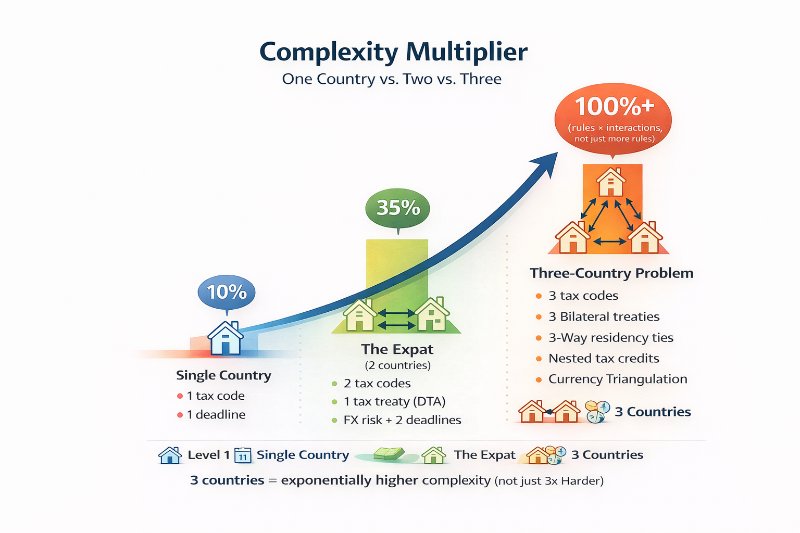
One country: You follow one set of rules. Complexity = 10 (arbitrary units)
Two countries: You follow two sets of rules PLUS the interaction between them (Double Taxation Agreement, residency tie-breakers, foreign tax credits). Complexity = 35
Three countries: You follow three sets of rules PLUS three bilateral relationships PLUS three-way interactions. Complexity = 100+
It's the jump from two to three that creates the exponential leap. This is why someone managing UK and UAE obligations finds it challenging but manageable, while someone managing UK, UAE, and US obligations finds it overwhelming.
How Common Is the Three-Country Problem?
More common than you might think - and growing rapidly.
The Numbers
According to the UN, over 300 million people live outside their country of birth. But the Three-Country Problem affects a specific subset:
Who typically faces this:
- US citizens abroad (citizenship-based taxation creates automatic third country)
- UK expats who maintain property or work ties after moving
- Indian NRIs with UK/US work and India property/investments
- Corporate relocations where family stays in home country
- Digital nomads working for clients in one country while living in another
- High-net-worth individuals with diversified international assets
Our data: During our market research with 40+ global professionals, we found that the majority track obligations across three or more countries simultaneously. The average professional we interviewed manages:
- 3+ countries of tax relevance
- 2-3 different currencies
- Multiple different income sources across jurisdictions
Why It's Growing
Remote Work Revolution
The shift to remote work post-2020 means you can live in Portugal while working for a US company with UK clients. Each jurisdiction has a potential claim on your income.
Digital Nomad Visas
Countries like Portugal, Estonia, Croatia, and many others now offer visas specifically for remote workers. But visa status doesn't determine tax statu - creating confusion about where obligations actually lie.
Global Investment Access
It's easier than ever to hold US stocks, UK property, and UAE bank accounts simultaneously. Each asset potentially creates tax obligations in its source country.
Citizenship-Based Taxation
The US taxes citizens regardless of where they live. This automatically creates at least a two-country problem, and often a three-country problem when combined with current residence and prior ties.
Why Standard Solutions Fail the Three-Country Problem
Tax Calculators: Built for One Jurisdiction
We've explored this in detail in our analysis of why tax calculators fail multi-jurisdiction professionals, but the core issue is simple: online tax calculators make four assumptions that break in three-country scenarios.
They assume:
- One jurisdiction determines all your tax rules
- One currency for all transactions
- One tax year (usually calendar year) tells the complete story
- One status (resident or non-resident) applies consistently
When you're dealing with the Three-Country Problem, every single assumption fails.
Example: The Calendar Assumption
You move from London to New York in March 2026. A standard calculator asks "What's your income?" and assumes one tax year.
Reality:
- UK tax year 2025/26 (April 2025 - March 2026): You were UK resident for 11 months
- US tax year 2026 (January - December): You became US resident in March
- UK tax year 2026/27 (April 2026 onward): Your status depends on ties and split-year treatment eligibility
Three different partial tax years, each with different rules, allowances, and rates. The calculator only models one.
Traditional Tax Advisors: Specialists in One or Two Countries
Most tax professionals specialize in one country's tax code, sometimes two if they focus on a specific corridor (like UK-US or India-UK).
When you present a Three-Country Problem, you often hear:
- "That's outside my area of expertise"
- "You'll need a specialist in [third country]"
- "This is more complex than I usually handle"
It's not that they're not good at what they do. It's that the Three-Country Problem requires expertise in three tax codes, three sets of treaty provisions, and the three-way interactions between them. That's genuinely rare.
The coordination problem -
Even if you hire three different specialists (one for each country), they often don't talk to each other. The UK advisor optimizes your UK position without knowing what the UAE advisor is doing, which might conflict with what the US advisor recommends.
Spreadsheets: Can't Handle the Complexity -
The DIY approach works for simple situations. But for the Three-Country Problem, spreadsheets encounter fundamental limitations:
Currency Complexity -
You need real-time FX rates across multiple currency pairs, compounded by the question of which rate to use for tax reporting purposes (spot rate? Average annual rate? Year-end rate?). Different countries have different requirements.
Tax Calculation Layers -
You're not just calculating one tax liability. You're calculating:
- Tax in Country A on all income
- Tax in Country B on Country-B-source income only
- Tax in Country C on worldwide income (if citizenship-based)
- Foreign tax credits in Country C for taxes paid in A and B
- Potential treaty relief reducing withholding in Country A
Each layer affects the others. Spreadsheet formulas become unmaintainable.
Compliance Tracking -
Different countries have different filing deadlines, different forms, different reporting thresholds. A spreadsheet can't remind you that your FBAR is due June 30, your UK self-assessment is due January 31, and your UAE tax residency certificate renewal is approaching.
The Three Dimensions in Detail
Dimension 1: Income Sources Across Jurisdictions
The first dimension of the Three-Country Problem is where your income originates. In a globalized economy, it's increasingly common to have income from multiple jurisdictions.
Employment Income Complexity
Scenario: Remote Worker -
You're employed by a German company, but you work remotely from Dubai, and occasionally travel to London for meetings.
Questions that arise:
- Which country taxes your employment income?
- Does it matter where you physically perform the work?
- What if you spend 40+ days working in the UK—does that trigger UK employment taxation?
- Does Germany still tax you even though you don't live there?
The answers depend on:
- Tax residency status in each country
- Employment contracts and where they're executed
- Physical presence (the UK's 40-day work rule)
- Germany-UAE DTA provisions
- Whether your presence in the UK creates a "permanent establishment" for your employer
Investment Income Complexity
Scenario: Global Portfolio
You hold:
- US stocks (dividends)
- UK rental property (rental income)
- Indian mutual funds (capital gains)
Each generates income with source-country taxation:
- US: 30% withholding on dividends (unless treaty reduces it)
- UK: 20% on rental income for non-residents
- India: Capital gains tax at Indian rates
Plus, your country of residence may also tax this income. The question becomes: which country has PRIMARY taxing rights, and how do you avoid double taxation?
This is where Double Taxation Agreements become critical - but only if you know they apply and actively claim the benefits.
Business and Freelance Income
Scenario: Consultant with Global Clients
You're a tech consultant living in Portugal, with clients in:
- United States (paying you in USD)
- United Kingdom (paying you in GBP)
- India (paying you in INR)
Tax questions:
- Portugal taxes you on worldwide income (you're resident)
- But do the source countries also tax you?
- US: Potentially, if you're providing services "in the US" (even remotely)
- UK: Same issue—where is the service "performed"?
- India: Indian clients may need to withhold tax at source
You need to understand:
- Whether you're considered self-employed, running a business, or providing dependent personal services (different treaty treatment)
- PE (Permanent Establishment) rules
- Service taxation in each source country
- How Portugal taxes foreign income and whether you can claim credits
Dimension 2: Tax Residency Across Multiple Countries
The second dimension is where you're considered a tax resident. This is more complex than "where you live" because:
- You can be tax resident in multiple countries simultaneously
- Residency tests vary by country
- Ties matter as much as (or more than) physical presence
UK Statutory Residence Test (SRT)
The UK determines tax residency through a multi-factor test that goes far beyond the 183-day rule. We've covered this in detail in our 3-point test for tax calculator accuracy, but here's the summary:
Automatic UK Resident if:
- You spend 183+ days in the UK, OR
- You have only one home and it's in the UK (available for 91+ days, spent 30+ days there), OR
- You work full-time in the UK
Automatic UK Non-Resident if:
- You spend fewer than 16 days in the UK (or fewer than 46 if you weren't UK resident in any of the previous 3 years)
Sufficient Ties Test if you're in between:
This is where it gets complex. If you spend 16-182 days in the UK, your residency depends on your "ties":
- Family tie: Spouse or minor children resident in UK
- Accommodation tie: UK home available 91+ days
- Work tie: Work in the UK 40+ days (3+ hours counts as a day)
- 90-day tie: In UK 90+ days in either of past 2 years
- Country tie: More days in UK than any other single country
The number of ties determines how many days you can spend before triggering UK residency.
Example: The "Only Home" Trap
You move from London to Zurich in March 2026. You keep your London flat "just in case" while you search for a home in Zurich. You spend 120 days in the UK during the 2026/27 tax year.
You think: "120 days is under 183, so I'm non-resident."
HMRC thinks: "You had a home available in the UK for more than 91 days, you spent at least 30 days there, and this was your only home for part of the year. You meet the accommodation tie. With 120 days and 2+ ties, you're a UK tax resident."
Result: Unexpected UK tax on your worldwide income.
German Center of Vital Interests
Germany looks at where your personal and economic life is centered:
- Where is your family?
- Where are your primary financial interests?
- Where do you have the closest personal ties?
- Where is your "habitual abode"?
Scenario: The Split-Family Problem
You take a job in Dubai. You move there and work there full-time. But your spouse and children stay in Germany (school, family reasons).
Days in Germany: 45 days (well under 183)
Days in UAE: 320 days
You assume you're UAE tax resident only.
German tax authorities may argue: "Your center of vital interests remains Germany. Your family is here. This is where your life is centered, regardless of where you physically work."
Outcome: Germany claims you as a tax resident. Now you need the Germany-UAE treaty to determine tie-breakers.
US Substantial Presence Test
The US uses a three-year formula for non-citizens:
You're US tax resident if:
- You're present 183+ days in the current year, OR
- You meet the "substantial presence" formula over 3 years:
- All days in current year
- 1/3 of days in prior year
- 1/6 of days in year before that
- Total ≥ 183 days
Plus: Even if you meet the test, you can claim treaty benefits if you have a "closer connection" to another country—but you must file forms proving it.
What Happens When You're Resident in Two Countries?
DTAs have tie-breaker rules, usually in this order:
- Permanent home: If you have one in only one country, you're resident there
- Center of vital interests: Where your personal and economic ties are closer
- Habitual abode: Where you routinely live
- Nationality: Last resort tie-breaker
But here's the critical point: treaty residency determines which country has PRIMARY taxing rights. It doesn't exempt you from filing or reporting in both countries.
You can still be domestically resident in both the UK and Germany, but the treaty determines that for treaty purposes, Germany has primary rights. You still file in both countries - you just claim treaty relief in the UK.
Dimension 3: Ongoing Tax Obligations in Third Countries
The third dimension is ongoing obligations in countries where you're not currently resident but still have ties, assets, or citizenship.
US Citizenship: The Automatic Third Country
If you're a US citizen, you have this built-in. The US taxes citizens on worldwide income regardless of where they live.
Scenario: US Citizen in UK with Indian Investments
- Country 1 (Income source): India (dividend income from Indian stocks)
- Country 2 (Residency): UK (you live and work in London)
- Country 3 (Citizenship): US (you're a US citizen)
Tax obligations:
- India: Withholds tax on dividends at source
- UK: You're UK tax resident, must report worldwide income including Indian dividends
- US: You must report worldwide income including Indian dividends
How you avoid triple taxation:
- India-UK DTA: Claim reduced withholding or credit in UK for Indian tax
- US foreign tax credit: Claim credit for UK tax (and potentially Indian tax)
- But you must file in all three countries
- FBAR required if Indian + UK accounts total >$10,000
- FATCA reporting required for foreign financial assets
This is the Three-Country Problem in its purest form.
Property in Home Country
Scenario: UK Expat in UAE with London Rental Property
- You live in Dubai (UAE tax resident, 0% personal income tax)
- You own a flat in London that you rent out
Tax obligations:
- UK: 20% tax on rental income (non-resident landlord rate)
- UAE: No personal income tax, but must declare the income
- You must file UK tax return annually for the rental income
- You remain in the UK tax system for this income stream
Complexity: What if you also have US investments? Now you're tracking:
- UAE residence (primary)
- UK rental income taxation
- US investment income taxation (withholding + potential treaty claims)
Three-Country Problem.
Pensions from Previous Employment
Scenario: Indian NRI in UK with Indian EPF
- You worked in India for 10 years, built up EPF (Employee Provident Fund)
- You now live and work in the UK
- You withdraw your EPF
Tax questions:
- Does India tax the withdrawal?
- Does the UK tax it?
- India-UK DTA: Which country has primary rights to tax pension income?
Answer (simplified): Generally, the residence country (UK) has primary rights. But you must report correctly in both countries and claim treaty relief.
The Hidden Costs of the Three-Country Problem
Beyond the complexity, there are real financial costs to mismanaging multi-jurisdiction taxation.
Time Cost
Research from our market interviews: Professionals managing three-country tax situations report spending an average of 40+ hours per tax season:
- Gathering documents across jurisdictions
- Currency conversions for reporting
- Understanding which forms are required where
- Coordinating information between multiple advisors
- Double-checking calculations
At a professional hourly rate of £100, that's £4,000 in time cost annually—before paying for any professional services.
Professional Fees
Cross-border tax specialists charge premium rates because the expertise is rare.
Typical costs:
- Single-country tax return: £300-800
- Two-country coordination: £1,500-3,000
- Three-country situation: £3,000-8,000+
The complexity multiplies the cost.
Opportunity Costs: Money Left on the Table
This is often the biggest hidden cost. Professionals who don't understand their full cross-border position miss opportunities:
DTA Benefits Not Claimed
As we explored in our research, many professionals with cross-border investment income miss treaty benefits under Double Taxation Agreements. While withholding tax might be deducted at 30%, treaty rates between many countries reduce this to 15% or less - but these benefits must be actively claimed through proper tax filing.
On a $100,000 dividend portfolio, that's potentially $15,000 unnecessarily paid annually.
Split-Year Treatment Not Applied
The UK's split-year treatment can limit your UK tax to only the portion of the year you were resident. If you don't know to claim it, you might pay UK tax on the full year's worldwide income instead of just the pre-departure portion.
Potential cost: £5,000-20,000 depending on income.
Wrong Foreign Tax Credit Calculations
The US foreign tax credit can offset UK taxes paid against US tax liability. But the calculation is complex (there are different "baskets" for different income types), and errors can mean double taxation.
The Stress and Anxiety Cost
This one's harder to quantify, but it's real. In our market research interviews with global professionals:
- 73% report "significant anxiety" about whether they're filing correctly
- 61% have "delayed financial decisions" due to uncertainty about tax implications
- 54% avoid certain investments because they "don't understand the tax treatment"
The Three-Country Problem isn't just expensive - it's paralyzing.
The Three-Country Problem in Action: Real Scenarios
Scenario 1: UK→UAE Corporate Relocation (Family Stays Behind)
The Setup:
- Person: Senior finance professional
- Move: London to Dubai for work (2026)
- Family: Spouse and two children remain in London (school continuity)
- Assets: London property (rental), UK pension, UAE salary
The Three Countries:
- UK (Home): Has property, family there, was resident
- UAE (Work): Works full-time, 320 days/year
- Past/ongoing UK ties: Rental income, pension
Tax Complexity:
UK Position:
Despite living in UAE, might still be UK tax resident due to:
- Family tie (spouse and children in UK 91+ days)
- Accommodation tie (London property available)
- Only spent 45 days in UK physically, but with 2-3 ties, this might trigger residency
If UK resident: Worldwide income taxed in UK (including UAE salary)
UAE Position:
- 0% personal income tax on employment income
- But need 183+ days for tax residency certificate
- Certificate needed to claim treaty benefits
Treaty Tie-Breaker:
If considered resident in both:
- Permanent home: Has one in both countries
- Center of vital interests: This is the question - family in UK, work in UAE
- Could go either way
What Went Wrong:
Didn't anticipate the family tie would keep UK residency. Assumed "working in UAE = UAE resident only." Now facing potential UK tax on UAE salary.
Cost: Depending on income levels, this type of miscalculation could result in unexpected tax bills ranging from £20,000 to £50,000 or more, plus potential penalties for underpayment.
How to Avoid:
- Plan family move or be prepared for UK residency
- Get professional advice before relocating
- Model both scenarios (family moves vs. stays)
- Consider timing (move at start of UK tax year for split-year treatment)
Scenario 2: US Digital Nomad (Portugal Residence, Multiple Client Countries)
The Setup:
- Person: Tech consultant
- Citizenship: United States
- Residence: Portugal (D7 visa, NHR regime)
- Clients: US companies (60%), UK companies (30%), Indian startup (10%)
The Three Countries (Plus):
- US (Citizenship): Must file, report worldwide income, citizenship-based taxation
- Portugal (Residence): Tax resident, foreign income potentially tax-free under NHR
- Client countries: UK and India have potential withholding/source taxation
Tax Complexity:
US Position:
- Must file Form 1040 reporting all income (US + foreign)
- Can claim Foreign Earned Income Exclusion (FEIE) to exclude ~$126,500
- Or claim Foreign Tax Credit for Portuguese tax paid
- Must file FBAR (foreign accounts exceed $10K)
- Must file FATCA Form 8938 (foreign assets exceed threshold)
Portugal Position:
- Tax resident (183+ days, center of life)
- Under NHR regime, foreign-source income potentially tax-free (if taxed in source country OR can be taxed per DTA)
- Portuguese tax authorities want proof income is "foreign-source"
- Must file Portuguese return
Source Countries:
- US clients: Payment to US citizen = potential US sourcing (complex)
- UK clients: May require UK withholding if services "performed in UK" (even remotely, this is grey area)
- Indian client: India may claim source taxation
What Went Wrong:
Thought "NHR = tax-free" and "FEIE = no US tax." Reality:
- NHR has conditions and reporting requirements
- FEIE doesn't eliminate US filing requirement
- Source countries may still withhold
- Didn't track days carefully (need proof of 183+ in Portugal)
- Didn't get Portuguese tax residency certificate to claim treaty benefits
Solution:
- Professional help coordinating US and Portugal filings
- Careful documentation of where work was performed
- Tax residency certificate from Portugal
- Claim FEIE for US (since Portugal isn't taxing under NHR)
- Track everything meticulously
Scenario 3: Indian NRI (UK Work, India Property, US Investments)
The Setup:
- Person: Software engineer
- Background: Grew up in India, moved to UK for work (2021)
- Current status: UK tax resident (SRT), Indian NRI
- Assets:
- India: Rental property in Mumbai, parents' gifted property, EPF account
- UK: Employment income, SIPP pension
- US: Stock portfolio (tech stocks, dividends)
The Three Countries:
- India (Origin): Has assets, income sources
- UK (Current residence): Lives and works there
- US (Investments): Dividend income subject to withholding
Tax Complexity:
Indian Position:
- NRI status (not in India 182+ days)
- Rental income from Mumbai property: Taxed in India at 30%
- Must file Indian tax return for rental income
- EPF withdrawal: Will India tax it?
- NRE vs NRO accounts: Must use correctly
UK Position:
- UK tax resident (lives there, works there)
- Worldwide income taxable: UK salary + India rental + US dividends
- Must report all income on UK self-assessment
- Can claim foreign tax credit for Indian tax paid on rental
- Can claim DTA relief for US withholding (reduce from 30% to 15%)
US Position:
- Not a US citizen/resident, but has US investments
- US withholds 30% on dividends automatically
- Can claim reduced 15% rate under US-UK treaty (but must file W-8BEN)
- Must track basis for eventual capital gains (if sold)
What Went Wrong:
- Didn't file W-8BEN, so US broker withheld 30% instead of 15%
- Didn't claim foreign tax credit in UK for Indian tax paid
- Used NRO account for foreign remittances (should use NRE)
- Didn't realize UK taxes worldwide income (thought only UK income)
Cumulative potential cost: Professionals in similar situations could overpay several thousand pounds annually through:
- Extra US withholding tax (if not claiming treaty benefits)
- Missing foreign tax credit claims in UK for Indian tax paid
- Account management inefficiencies
Solution:
- File W-8BEN with US brokers (reduce withholding to 15%)
- Claim foreign tax credit on UK return for Indian rental tax
- Use NRE account for foreign income remittances
- Consider: Move US portfolio to UK-domiciled funds (avoid US withholding entirely)
- Annual cross-border tax specialist review
What Makes the Three-Country Problem Uniquely Complex
The leap from two countries to three countries isn't just "50% more complicated." It's exponentially more complex because of the interaction effects.
The Mathematics of Multi-Jurisdiction Complexity
One Country:
- 1 tax code to understand
- 1 set of filing requirements
- 1 deadline
- Complexity factor: 10
Two Countries:
- 2 tax codes
- 2 sets of filing requirements
- 1 Double Taxation Agreement
- Residency determination (which country?)
- Foreign tax credit calculations
- 2 deadlines
- Complexity factor: 35
Three Countries:
- 3 tax codes
- 3 sets of filing requirements
- 3 Double Taxation Agreements (A-B, A-C, B-C)
- 3-way residency tie-breakers
- Multiple foreign tax credit calculations across jurisdictions
- Source vs. residence taxation conflicts
- 3 deadlines
- Currency triangulation (if all three use different currencies)
- Complexity factor: 100+
Why Bilateral Solutions Don't Work for Trilateral Problems
Double Taxation Agreements are bilateral—they govern the relationship between two countries. When you have three countries, you have three bilateral relationships:
- DTA between Country A and Country B
- DTA between Country A and Country C
- DTA between Country B and Country C
But there's no trilateral agreement that governs all three simultaneously. You must apply multiple treaties and hope they don't conflict.
Example: The Foreign Tax Credit Problem
You earn income in Country A, live in Country B, and are a citizen of Country C (which taxes worldwide income).
- Country A taxes it (source taxation)
- Country B taxes it (residence taxation)
- Country C taxes it (citizenship-based taxation)
DTAs say:
- A-B treaty: B has primary right, A must give credit
- A-C treaty: C has primary right (savings clause for citizens)
- B-C treaty: B has primary right for residents
You need to:
- Pay tax in Country A (source withholding)
- Report in Country B, claim credit for A tax
- Report in Country C, claim credit for B tax (which already includes credit for A)
The calculation becomes nested and complex. Get one layer wrong, and you're either double-taxed or under-taxed (which triggers penalties).
How Modern Technology Is Solving the Three-Country Problem
For decades, the Three-Country Problem was genuinely unsolvable without expensive specialist help. The moving pieces were too complex, the data too dispersed, the calculations too intricate.
But technology is changing this - not by replacing advisors, but by giving professionals the tools to understand their situation clearly before seeking advice.
What Modern Platforms Should Handle
1. Multi-Currency Wealth Aggregation
Track assets across any currency combination with real-time FX updates. See your true net worth in your chosen base currency, updated automatically.
This matters because your wealth isn't static when measured across currencies. A £100,000 UK property might be worth $135,000 one month and $122,000 the next - not because the property changed value, but because GBP/USD moved.
Understanding this impact is crucial for financial planning. We explored this in depth in our guide on multi-currency wealth tracking.
2. Tax Residency Modeling
Model your residency status across multiple countries based on:
- Days spent (automatic tracking or manual input)
- Ties (family, accommodation, work)
- Relevant tests (SRT for UK, substantial presence for US, center of vital interests for Germany)
See how scenarios change: "What if I spend 30 more days in the UK?" or "What if I sell my London property?"
3. Treaty-Aware Tax Calculations
Apply DTA provisions automatically:
- Which country has primary taxing rights?
- What's the reduced withholding rate?
- Can you claim foreign tax credits?
- What documentation is required?
This isn't about calculating your exact tax liability (that requires a professional). It's about understanding the framework and seeing scenarios.
4. Compliance Calendar Management
Track filing deadlines across all your jurisdictions:
- April 15: US tax due (or June 15 with automatic extension for expats)
- January 31: UK self-assessment deadline
- June 30: FBAR deadline
- Country-specific form filing (W-8BEN renewals, etc.)
Get reminders weeks in advance, not day-of.
5. Impact Modeling: FX, Inflation, and Tax
See how your wealth is affected by:
- Currency fluctuation (your £200K UK assets lost 8% in USD terms due to FX)
- Inflation differentials (UK 4%, UAE 2% -your UK assets eroding faster)
- Tax drag (your gross wealth vs. your spendable wealth after tax obligations)
This is the unique angle that no traditional wealth tracker handles. Your "net worth" isn't one number - it's different depending on where you plan to spend it and when.
What Settel Does Differently
This is why we built Settel. We looked at the Three-Country Problem and realized that existing solutions were all designed for simpler scenarios:
- Wealth trackers (Mint, Personal Capital) assume one country
- Multi-currency trackers (Finary, Kubera) miss the tax layer
- Tax software (TurboTax, TaxAct) assume one or two countries max
- Spreadsheets can't scale with the complexity
Settel is built specifically for the Three-Country Problem:
✅ Multi-currency native: Track wealth in any combination of currencies with real-time FX
✅ Tax-aware: Model obligations across US, UK, India, UAE (expanding)
✅ Treaty logic: Understand which DTAs apply to your income
✅ Inflation tracking: See real wealth erosion, not just nominal
✅ Compliance engine: Never miss a deadline across jurisdictions
✅ Scenario modeling: "What if I move?" "What if I sell this asset?"
We don't provide tax advice. We don't file your returns. We provide information and planning tools that help you understand your position clearly- so when you do work with a tax professional, you're asking the right questions and providing the right data.
Think of it as the difference between showing up to a doctor with "I don't feel well" versus showing up with "Here's my tracked symptoms, vitals, and timeline over the past month." The doctor is still the expert. But you're making their job more efficient - and getting better results.
Your Next Steps: Navigating the Three-Country Problem
If you recognize yourself in these scenarios, here's your action plan.
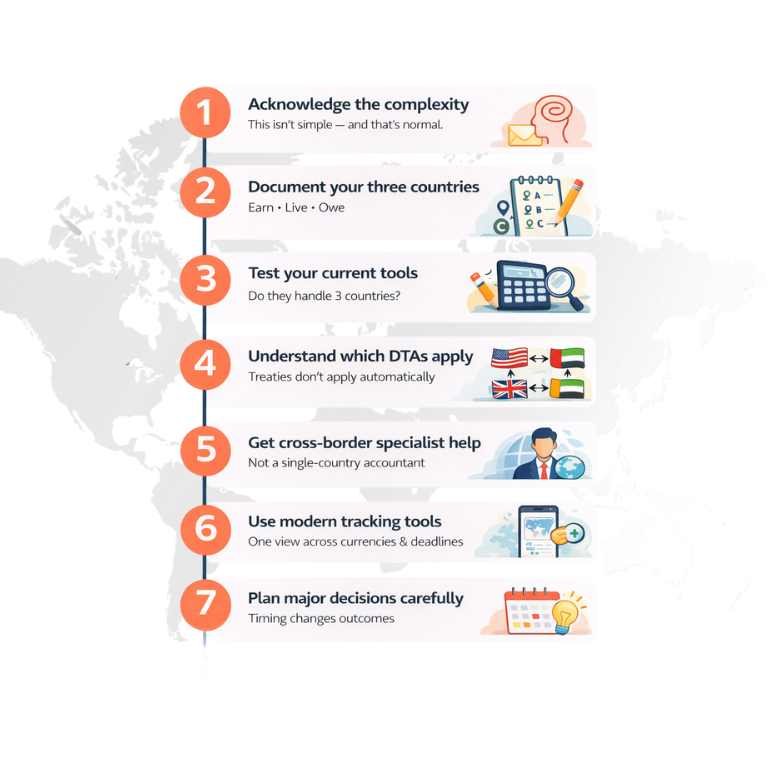
Step 1: Acknowledge the Complexity
First, give yourself permission to find this complicated. The Three-Country Problem is complicated. It's not a failure of understanding on your part - it's a genuinely complex situation that breaks most standard tools and processes.
Step 2: Document Your Situation
Before you talk to anyone or use any tool, you need clarity on your own position:
Map your three countries:
- Where do you earn income? (List all sources)
- Where are you tax resident? (May be more than one)
- Where else do you have obligations? (Citizenship, property, pensions)
Track your presence:
- How many days in each country this tax year?
- Where is your family?
- Where do you have property available?
- Where do you work?
List your income and assets by jurisdiction:
- Country A: Employment $120K, investment account $50K
- Country B: Rental property £200K (generating £15K/year)
- Country C: Pension pot $80K
This documentation is the foundation for everything that follows.
Step 3: Test Your Current Tools
If you're using a tax calculator or working with an accountant, run them through our 3-point test to see if they're actually equipped for multi-jurisdiction complexity:
- Does your calculator ask for your move date? (Tax year alignment)
- Does it ask about your ties? (Family, home, work - not just days)
- Does it account for DTAs? (Treaty provisions, not just default withholding)
If the answer to any of these is "no," your numbers may not reflect reality.
Step 4: Understand Which Double Taxation Agreements Apply
You don't need to become a treaty expert, but you should know:
- Do DTAs exist between your three countries?
- Which articles potentially apply to your income types?
- What documentation is required to claim benefits?
Resources:
- OECD Tax Treaties Database: Verify which treaties exist
- Your country's tax authority website: Often publishes treaty guides
- Tax treaty networks: See how agreements interact
Step 5: Get the Right Professional Help
Not all tax professionals are equipped for the Three-Country Problem. You need someone with:
- Cross-border expertise (not just domestic)
- Experience in your specific country combination
- Knowledge of DTAs and how they interact
- Ability to model scenarios, not just file returns
Budget realistically: Cross-border specialists charge £1,500-5,000+ for comprehensive work. This feels expensive until you realize the cost of getting it wrong is £10,000-50,000 in unexpected tax bills or missed opportunities.
Step 6: Use Modern Tools to Support Your Specialist
Technology can't replace professional advice, but it can make that advice more efficient and effective.
Tools should help you:
- Track your position throughout the year (not just at tax time)
- Model scenarios before making decisions
- Organize documentation across jurisdictions
- Monitor compliance deadlines
- Understand the impact of FX and inflation on your wealth
This is what Settel is built for. Join our beta to see how tracking your Three-Country Problem with modern tools changes the conversation with your advisor.
Step 7: Plan Major Decisions Carefully
The Three-Country Problem means that financial decisions have cascading implications:
Before you move countries:
- Model the tax implications of different move dates
- Understand split-year treatment eligibility
- Plan what to do with property, pensions, existing investments
- Consider family logistics (do they move with you or stay?)
Before you sell assets:
- Which country taxes the capital gain?
- Can you claim treaty relief?
- What's the impact of FX gains/losses?
- Does timing matter (tax year considerations)?
Before you change job structures:
- Employment vs. contracting: different tax treatment
- Remote work across borders: where is income sourced?
- Stock options vesting: which country taxes them?
None of these should be spontaneous decisions when you have the Three-Country Problem. Model them first.
The Future of Multi-Jurisdiction Financial Management
The Three-Country Problem isn't going away. If anything, it's becoming more common:
- Remote work continues to grow
- Digital nomad visas proliferate
- Global investment access expands
- Citizenship-based taxation persists (US)
- Families increasingly live across borders
But the tools to manage it are finally catching up to the complexity.
What's changing:
- Integrated platforms that track wealth + tax + compliance together
- AI-powered treaty matching and provision application
- Real-time FX and inflation impact modeling
- Cross-border specialist networks that collaborate digitally
- Regulatory technology that tracks changing rules across jurisdictions
What you can expect in the next 2-3 years:
- Better integration between tracking tools and tax professionals
- More sophisticated scenario modeling
- Easier documentation and record-keeping
- Proactive alerts for tax law changes affecting you
- Community knowledge sharing among expats with similar situations
The Three-Country Problem is complex. But it's solvable - especially when you have the right tools, the right information, and the right professional support.
Key Takeaways
If you take nothing else from this guide, remember:
The Three-Country Problem is real and growing. If you earn in one country, live in another, and have obligations in a third, standard tools and advisors aren't built for your situation.
Complexity is exponential, not linear. Three countries isn't 50% more complex than two - it's 3-5x more complex because of interaction effects.
Your wealth isn't one number. When measured across currencies, affected by differential inflation, and reduced by multi-jurisdiction tax obligations, your "net worth" is a moving target.
DTAs help, but only if actively claimed. Treaty benefits don't apply automatically. You must know they exist, understand which provisions apply, and file correctly to benefit.
Day-counting isn't enough. Modern residency tests (UK SRT, German center of vital interests) care about your ties as much as your physical presence.
Professional help is worth it. The cost of a cross-border specialist (£1,500-5,000) is far less than the cost of errors (£10,000-50,000+).
Technology bridges the gap. Modern platforms can't replace advisors, but they can help you understand your position, model scenarios, and manage compliance - making your professional advice more efficient.
The Three-Country Problem challenges assumptions about how tax and wealth management work. But with the right framework, the right tools, and the right support, it's navigable.
Frequently Asked Questions
What exactly is the Three-Country Problem?
The Three-Country Problem occurs when an individual earns income in one country, maintains tax residency in a second country, and has tax obligations (through citizenship, property, or prior residency) in a third country. This creates exponential complexity because you must navigate three tax codes, three sets of compliance requirements, and the interactions between three bilateral tax treaties.
How do I know if I have a Three-Country Problem?
You likely have a Three-Country Problem if:
- You're a US citizen living anywhere outside the US (citizenship-based taxation creates automatic third country)
- You live in one country, work remotely for clients in another, and have property/investments in a third
- You've relocated for work but maintained family, property, or financial ties in your home country
- You earn income from sources in three or more different countries
- You're tax resident in one country but earn income that's sourced in others
Run through the self-assessment: List where you earn income, where you're tax resident, and where else you have obligations. If these span three jurisdictions, you're in Three-Country Problem territory.
Why can't standard tax calculators handle the Three-Country Problem?
Standard tax calculators make four assumptions that break in multi-jurisdiction scenarios: (1) one jurisdiction determines all tax rules, (2) one currency for all transactions, (3) one tax year tells the complete story, and (4) one residency status applies consistently. When you have the Three-Country Problem, all of these assumptions fail. Tax years don't align across countries, currencies require constant conversion, residency might be dual or split-year, and different income sources face different tax treatment across multiple jurisdictions.
What's the difference between being tax resident in two countries vs. three countries?
The complexity isn't just additive - it's multiplicative. With two countries, you have one tax relationship to manage (one DTA, one set of residency tie-breakers, one foreign tax credit calculation). With three countries, you have three bilateral relationships (three DTAs that may conflict), multiple potential residency determinations, and nested foreign tax credit calculations where credits from Country A flow through Country B's calculation before reaching Country C. The number of interacting rules increases exponentially.
Can Double Taxation Agreements solve the Three-Country Problem?
DTAs help, but they're bilateral—they govern the relationship between two countries only. When you have three countries, you have three separate bilateral relationships. You must apply multiple treaties and ensure they don't conflict. Additionally, DTAs determine which country has PRIMARY taxing rights, but they don't necessarily eliminate filing requirements in all countries. You may still need to file returns in all three jurisdictions and claim treaty relief through proper documentation.
How much does it cost to properly manage a Three-Country Problem?
Professional costs: Cross-border tax specialists typically charge £1,500-5,000+ annually for comprehensive Three-Country Problem advisory and filing services. This varies based on complexity and income levels.
DIY time cost: If managing yourself, expect 40+ hours per tax season for research, documentation, calculation, and filing across jurisdictions.
Cost of errors: Getting it wrong can result in unexpected tax bills ranging from £10,000-50,000+, plus penalties and interest. The professional cost is almost always less than the error cost.
Opportunity cost: Many professionals miss DTA benefits worth thousands annually simply because they don't know these benefits exist or how to claim them.
Is the Three-Country Problem only for wealthy people?
No. While high-net-worth individuals often face greater complexity due to diverse asset holdings, the Three-Country Problem affects professionals across income levels. A software developer earning £60,000 can easily encounter it: working remotely from Portugal for a UK company while being a US citizen with US student loans. Income level affects the dollar amounts at stake, but not whether the complexity exists.
What should I do if I've already made tax filing mistakes due to the Three-Country Problem?
Many countries have voluntary disclosure or "streamlined" procedures for correcting past errors. The sooner you address it, typically the better the outcome. Penalties are often reduced or eliminated for voluntary corrections. Steps: (1) Don't panic, (2) Engage a cross-border tax specialist immediately, (3) Document what you've filed and what should have been filed, (4) Follow the specialist's advice on correction procedures. Each country has different amnesty/correction programs - professional help is essential here.
How is Settel different from other wealth tracking apps for the Three-Country Problem?
Most wealth trackers (Mint, Personal Capital) are single-country focused and don't support multi-currency or multi-jurisdiction tax scenarios. Multi-currency trackers (Finary, Kubera) handle currencies well but don't model tax obligations across jurisdictions. Settel is specifically built for the Three-Country Problem with: multi-currency wealth tracking with real-time FX, tax obligation modeling across US/UK/India/UAE (expanding), Double Taxation Agreement logic, inflation differential tracking, and compliance deadline management across jurisdictions. We don't provide tax advice or filing services—we provide information and planning tools to help you understand your position and work more effectively with your tax professional.
Related Topics: Multi-jurisdiction tax planning, cross-border taxation for individuals, expat tax complexity, dual residency tax strategies, multi-country tax residency, global wealth management, Double Taxation Agreements, tax residency tests
Tags: #ThreeCountryProblem #MultiJurisdictionTax #CrossBorderTax #ExpatTax #GlobalWealth #TaxResidency #DoubleTaxation #ExpatFinance
Disclaimer: The information provided in this article is for general educational purposes only and should not be construed as tax, legal, or financial advice. Tax laws and regulations are complex, vary by jurisdiction, and are subject to change. The scenarios provided are illustrative and for educational purposes only. Individual circumstances vary significantly, and what applies to one person may not apply to another. Settel provides information and planning tools but does not provide tax, legal, or financial advice. We strongly recommend consulting with qualified tax professionals, accountants, or legal advisors who are familiar with the specific tax laws and treaties relevant to your situation before making any decisions or taking any actions based on this information.
Take Control of Your Three-Country Problem
The gap between understanding your multi-jurisdiction tax position and actually managing it shouldn't require a finance degree and 40 hours per tax season.
Settel helps you:
- Track your global wealth across any currency combination
- Understand your tax obligations in the US, UK, India, UAE, and beyond
- See how FX fluctuation and inflation affect your real wealth
- Model scenarios before making major financial decisions
- Never miss a compliance deadline across any jurisdiction
We're currently launching our beta with phased cohorts. Join our waitlist of 80+ professionals to get early access.
Join the Settel waitlist today - 2-week free trial, then £49/year.
Built for the Three-Country Problem. Built for professionals like you.