
· 8 min read
Rohan has been in the UK for four years. Indian national, London-based, salary from a UK employer. He also holds Indian equity mutual funds paying annual dividends - around £4,200 last year. He ran a popular expat tax calculator to check his position, got a number, and was about to file on it.
Both key figures the calculator gave him were wrong. The Indian withholding rate it applied was 20% - the domestic rate - not the 10% cap that applies under Article 11 of the India-UK Double Taxation Agreement as amended by the 2012 Protocol. (HMRC DT9552) And the Indian tax already withheld at source? The calculator treated it as a cost. It should have been a credit against his UK liability, claimed via Foreign Tax Credit Relief on SA106. (HMRC HS263) On £4,200 of dividends, these two errors compound quietly, year after year, until someone checks. Most people don't check.
Can I rely on an expat tax calculator if I have income in more than one country?
Probably not - at least not as your primary tool. Generic calculators are built for single-country filers. They ignore treaty withholding caps, Foreign Tax Credit Relief, Statutory Residence Test ties analysis, and split-year treatment. If you have income, assets, or residency ties in more than one country, use a calculator as a rough cross-check only. Don't file on it.
What is the Three-Country Problem?
The Three-Country Problem is when you live in one country, earn in another, and hold assets or investments in a third. It creates layered tax and treaty interactions - across residency tests, withholding rules, foreign tax credits, and filing deadlines - that generic calculators rarely model correctly. It is the central problem Settel is built to address.
How do expat tax calculators get multi-country income wrong?
Generic tools assume single-country residency, apply domestic withholding rates without checking treaty positions, ignore Foreign Tax Credit Relief, and miss split-year treatment for people who moved mid-tax-year. Each error compounds the next. A calculator that gets your residency classification wrong will also get your treaty entitlement wrong, and your credit claim wrong after that.
When do you actually need a cross-border tax specialist?
When your situation involves dual residency risk, treaty elections, Foreign Tax Credit Relief across multiple income types, or a mid-year move. A general accountant can file accurately for a single-jurisdiction return. A cross-border specialist understands treaty provisions, Statutory Residence Test ties analysis, and split-year treatment — the issues that calculators and general accountants most commonly miss.
Why Generic Expat Tax Calculators Misfire on Multi-Country Income
Generic calculators are built for one-country filers. They assume a single residency, a single tax year, and income originating where you live. When any of those assumptions break, the output is wrong - sometimes by a small amount, sometimes by a significant one.
I built Settel because I lived this. Moving between Kuwait, India, and the UK, I had income from multiple sources in multiple countries - and every calculator I tried flattened that complexity into a single-country model that missed the treaty interactions entirely. The errors weren't dramatic line items. They were quiet accumulations: a withholding rate applied at the wrong level here, a credit not claimed there. By the time you notice, you've either overpaid for years or have an exposure you didn't know existed. That's what I wanted to fix.
The most common failure patterns:
Single-country residency assumption. Most tools use a 183-day heuristic. Under the UK's Statutory Residence Test, the actual threshold depends on your number of ties - family, property, work history, prior residency. A person with three ties can become UK resident with as few as 46 days in the UK in the current tax year. (HMRC RDR3) A calculator that ignores this will classify the same person as non-resident and produce a materially wrong liability figure.
Domestic withholding rates applied without checking treaty positions. India's domestic dividend withholding rate is higher than the 10% cap under the India-UK DTAA. A calculator that applies the domestic rate rather than the treaty rate overstates the Indian tax position. The same applies to US brokerage dividends under the US-UK treaty, or to income from other corridors where a DTA exists.
Foreign Tax Credit Relief not modelled. Indian tax withheld at source — if correctly applied at the treaty rate — is creditable against UK tax on the same income. Under the UK's FTCR rules, foreign tax paid reduces your UK liability on the same income, up to a cap. Calculators that treat source-country withholding as a final cost rather than a creditable payment double-count the liability.
Split-year treatment ignored. If you moved to or from the UK mid-tax-year, the year divides into a UK-resident part and an overseas part. Split-year treatment must be actively claimed on your Self Assessment via supplementary form SA109 - it is not automatic. (HMRC SA109) A calculator that treats the whole year as either fully resident or fully non-resident misallocates potentially several months of worldwide income.
Prior-year residency ignored. Your UK residency status in the three years before the current tax year affects which SRT tests apply and whether a country tie is in scope. Calculators that assess only the current year miss this entirely.
Checklist: When an expat tax calculator is likely wrong
- You have income or assets in more than one country
- The calculator only asked for your day count, not your UK ties
- It applied a withholding rate without mentioning the applicable tax treaty
- It showed foreign tax withheld as a cost, not a potential credit
- It did not ask whether you moved mid-tax-year
- It did not ask where your family lives or whether you have property available to you in another country
If two or more of these apply, your output is likely incorrect. Do not file on the basis of it.
Quick Triage for Expats: Do You Have a Multi-Country Tax Calculator Problem?
Before spending time and money on specialist advice, establish whether your situation is genuinely beyond what a standard tool can handle.
Indicators that your calculator is likely wrong:
- You have income or assets in more than one country
- You moved to or from the UK mid-tax-year
- You have a property, spouse, or employer in a different country from where you live
- You are a US citizen or long-term green card holder — you file US returns regardless of where you live
- You spent more than 30 days in more than two countries this year
- Your Indian broker or fund house has withheld tax at source
- Your calculator did not ask where your family lives or whether you have property available to you in another country
If two or more of these apply, use a single-country calculator as a rough cross-check only, not as the basis for a filing decision.
Indicators that a standard calculator may be adequate:
- You made a clean break - sold property, moved family, severed ties - at the start of a full tax year
- All your income is from employment in your current country of residence
- You have no investments, property, or income sources elsewhere
- You spent fewer than 16 days in the UK (if UK resident in one of the prior three years) or fewer than 46 days (if not)
A single consultation with a cross-border specialist will tell you which category you fall into faster than any calculator.
| Profile | Calculator risk |
|---|---|
| UK resident with Indian equity mutual fund dividends | HIGH- treaty withholding and FTCR likely missed |
| US citizen living in UK | HIGH - US filing obligation not modelled |
| Expat who moved to UK mid-tax-year | HIGH - split-year treatment requires active SA109 claim |
| UK resident, clean break, all income from UK employer | LOW - standard tools adequate |
| UK resident with UAE rental property income | MEDIUM - depends on rental structure and remittance position |
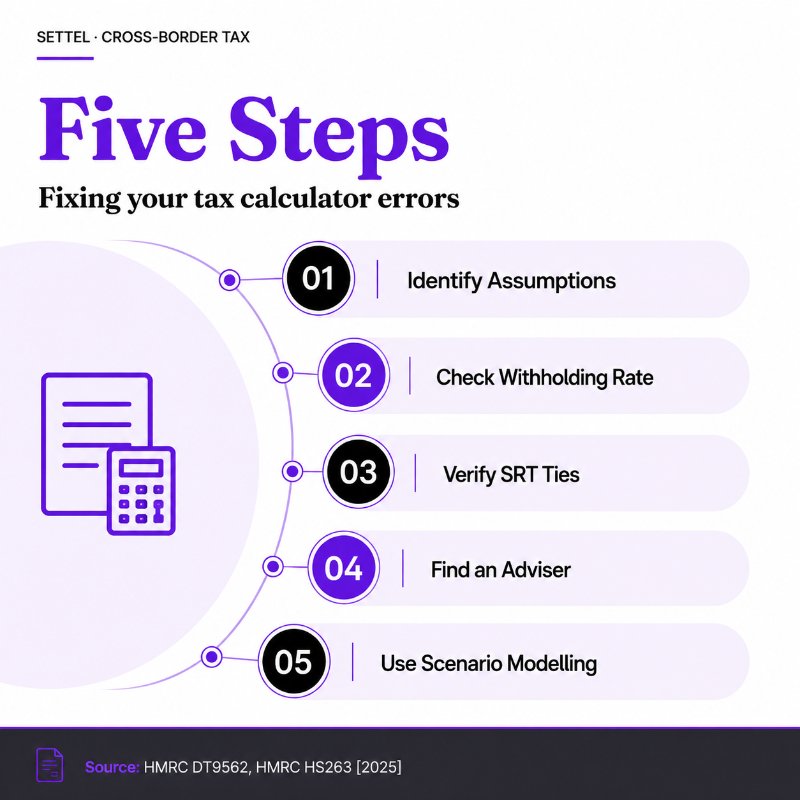
Step 1: Reconstruct What the Calculator Actually Assumed
Before calling anyone, establish exactly where your calculator went wrong. Export or screenshot the tool's inputs and outputs, then check each of these:
What residency did it assume? Did it ask about your ties - family location, property availability, work history — or only your day count? A tool that compares days to 183 only is not applying the SRT.
What tax year did it use? The UK tax year runs 6 April to 5 April. India runs 1 April to 31 March. The US runs the calendar year. A calculator using the wrong year boundary will misallocate income between periods.
Did it tag income by country of origin? UK salary, Indian dividends, and UAE rental income are taxed differently and attract different treaty positions. A tool that treats all income as domestically sourced will miss every treaty entitlement.
Did it apply the treaty withholding rate or the domestic rate? Under the India-UK DTAA, the withholding cap for standard equity dividends paid to a UK resident is 10%. If your calculator used a higher rate, it overstated the Indian tax withheld.
Did it credit the withholding against your UK liability? Indian tax withheld at the correct treaty rate is creditable against UK Income Tax on the same income, via Foreign Tax Credit Relief on SA106. Foreign Tax Credit Relief lets you offset tax paid in another country against your UK tax on the same income, up to certain limits set by HMRC. If your calculator showed Indian withholding as a cost rather than a credit, it counted the tax twice.
Rohan's numbers: what the calculator showed vs the correct position
| Calculator output | Correct position | |
|---|---|---|
| Indian dividend income | £4,200 | £4,200 |
| Indian withholding rate applied | 20% (domestic rate) | 10% (DTAA treaty rate, Article 11, as amended by 2012 Protocol) |
| Indian tax withheld | £840 | £420 |
| UK tax treatment | Full £4,200 at marginal rate - no credit applied | £4,200 assessed, with £420 Indian tax credited via SA106 under FTCR rules |
| Net result | Indian tax overpaid + UK liability overstated | Correct withholding + reduced UK liability via FTCR |
This is a single income stream, one year. Three income sources across two corridors over four years, and the compounding effect is substantially larger. The calculator cannot model this.
These figures are illustrative. The actual tax position depends on total UK income, personal allowance usage, and treaty paperwork in place. Use Settel's Smart Tax Engine to model your specific numbers.
Step 2: Check the Treaty - Where Expat Tax Calculators Most Often Go Wrong
If you have income from India, the US, or the UAE, there is likely a Double Taxation Agreement in play. HMRC publishes the full text of all UK treaties at gov.uk/hmrc-internal-manuals/international-manual.
What DTAs do: they allocate taxing rights between countries, cap withholding rates at source, and allow your country of residence to credit foreign tax paid. A Double Taxation Agreement prevents the same income being taxed twice — typically by giving the residence country a credit for tax paid at source in the other country, rather than by exempting the income entirely.
Three things calculators typically miss on treaty positions:
The withholding cap. Under the India-UK DTAA, standard equity dividends paid by an Indian company to a UK resident are capped at 10% withholding — not the higher domestic Indian rate. (HMRC DT9552) This cap applies only if you qualify and have the right paperwork in place.
The credit mechanism. To claim Foreign Tax Credit Relief in the UK on Indian-source dividends, you record foreign income and the tax paid on form SA106 and calculate the relief using HMRC helpsheet HS263. The credit is capped at the lower of the foreign tax paid and the UK tax on the same income. (HMRC HS263)
The paperwork requirement. Accessing treaty rates is not automatic. For Indian-source income, you typically need a UK Tax Residency Certificate from HMRC and may need to file Form 10F in India. Without the right documentation, the broker applies the domestic rate regardless of the treaty.
For a detailed walkthrough of the India-UK corridor specifically, see our India-UK DTAA guide [INTERNAL LINK PLACEHOLDER - replace when post is live].
Step 3: The 183-Day Myth and How the UK SRT Actually Works
The most common calculator assumption that causes problems for expats with global income: fewer than 183 days in the UK means you are not UK tax resident.
This is not how the Statutory Residence Test works.
The UK Statutory Residence Test looks at both day counts and UK ties. Someone with multiple ties can be UK resident with far fewer than 183 days in the country. Under the SRT's sufficient ties test, the number of permitted UK days reduces as your ties increase. A person who was UK resident in one or more of the prior three years, and who has three ties, can be UK resident with as few as 46 days in the UK in the current tax year. (HMRC RDR3)
The relevant ties are: family (spouse, civil partner, or minor child UK resident), accommodation (a UK property available for at least 91 days, with at least one overnight stay), work (40 or more days of substantive UK work in the year), 90-day history (more than 90 days in the UK in either of the two prior tax years), and country tie (the UK is where you spend the most days — applies if previously UK resident).
A calculator that asks only for your day count and returns a non-resident conclusion is giving you incomplete information. It has not assessed your ties, and therefore has not applied the SRT correctly.
Step 4: General Accountant vs Cross-Border Tax Specialist - Which Do Expats Actually Need?
Once you know your calculator was wrong, the question is who fixes it. The answer depends on what kind of error it was.
| General Accountant | Cross-Border Tax Specialist | |
|---|---|---|
| Jurisdiction expertise | One country's tax code | Multiple countries' tax systems |
| Treaty knowledge | Limited or none | Specific articles, elections, credits |
| Residency testing | Likely uses 183-day heuristic | Models SRT ties and thresholds correctly |
| Split-year treatment | May miss the SA109 claim | Core competency |
| Can diagnose expat tax calculator errors across two+ systems | Unlikely | Yes |
| Foreign Tax Credit Relief | May not identify what is claimable | Calculates and claims correctly |
| Best for | Clean, single-jurisdiction filing | Any multi-country income, asset, or residency situation |
What to bring to the first call:
Your calculator output, noting which inputs it did and did not ask for. A list of every country where you have income, assets, or spent significant time this year. Past returns from all relevant countries. Details of withholding tax already deducted at source. Any upcoming changes - property sales, job moves, change of family location.
Finding a cross-border specialist:
Green flags: they ask detailed questions about your ties before offering any view; they reference specific treaty articles; they explain multiple scenarios and trade-offs; they have handled your specific corridor before.
Red flags: they say "just stay under 183 days"; they cannot explain the SRT sufficient ties test; they have no experience with your country combination.
Where to look: boutique expat tax firms, Big 4 international tax divisions (PwC, Deloitte, EY, KPMG), the Society of Trust and Estate Practitioners (STEP).
Step 5: Use Scenario Modelling Tools, Not Static Expat Tax Calculators
The difference between a static calculator and a scenario modelling tool: a calculator gives you one answer based on fixed assumptions. A scenario tool lets you change the assumptions and see what moves.
That matters because multi-country tax is driven by decisions - when you move, when you sell a property, which country you work in on which days, whether your spouse joins you or stays behind. A static tool cannot show you what changes if you move on 1 April versus 1 June, or if you sell your Indian mutual funds before the UK tax year closes. A scenario tool can.
What to look for in a tool for expat taxes on global income: multi-year residency modelling; day-count tracking that includes tie analysis, not just day totals; income tagged by country of origin; treaty flags that indicate where DTA relief may apply; multi-currency support with correct tax-year boundaries for each jurisdiction.
Settel is a modelling and tracking tool for global income, residency days, and treaty flags across the UK, India, UAE, and US. The Smart Tax Engine models your position across jurisdictions and flags where treaty provisions may apply to your income types. The day-count tracker monitors your SRT thresholds - including the sufficient ties conditions that most calculators ignore. Settel AI can surface potential optimisation scenarios across your full multi-jurisdiction picture, in plain English - for you and your qualified adviser to review together.
Settel does not file returns or provide tax advice. It is the preparation layer - so that when you sit with a specialist, you are asking the right questions with the right data, not reconstructing your financial picture from three different spreadsheets.
For a deeper look at what to test before trusting any multi-jurisdiction calculator, see The Three-Country Tax Test: When Your Expat Tax Calculator Gives the Wrong Answer
Step 6: Track Properly So This Doesn't Happen Next Year
Understanding your tax position once is not enough. Multi-country tax is sensitive to daily decisions - where you work, where you sleep, when you receive income.
Track daily: physical location, which country you are working in on work days, overnight stays in properties you own or have available to you.
Track monthly: income received and from which source; Indian TDS certificates as they arrive; any changes in family location or property availability.
Review quarterly: your day count against each SRT threshold; whether your ties position has changed; whether treaty paperwork — Tax Residency Certificate, Form 10F - needs to be renewed or filed.
Settel's day-count tracker monitors your residency thresholds across jurisdictions and flags when you are approaching a limit, not after you have crossed it. That distinction matters: once you have crossed an SRT sufficient ties threshold, the residency status for the whole year is often already determined.
Glossary
Three-Country Problem - When you live in one country, earn in another, and hold assets in a third. Creates layered tax and treaty obligations that single-country tools cannot model.
Statutory Residence Test (SRT) - The UK's formal test for determining individual tax residency. Applies a combination of day counts and ties (family, property, work, prior residency). Not a simple 183-day rule.
Double Taxation Agreement (DTA / DTAA) - A bilateral treaty between two countries that allocates taxing rights, caps withholding rates, and provides mechanisms (usually tax credits) to prevent the same income being taxed twice.
Foreign Tax Credit Relief (FTCR) - The UK mechanism by which tax paid in another country on income also taxable in the UK is credited against your UK tax liability on that income. Claimed via SA106 and calculated using HMRC HS263. Capped at the lower of foreign tax paid and UK tax due.
Split-year treatment - Rules that divide a UK tax year into a resident part and a non-resident part when an individual moves to or from the UK mid-year. Must be actively claimed on Self Assessment via form SA109. Not automatically applied by HMRC.
Frequently Asked Questions
What should I do if my expat tax calculator shows a number that doesn't look right?
Start by checking what the calculator assumed about your residency. Did it ask about your ties - family location, property availability, prior-year UK residency — or only your day count? Did it ask where each income source originated? Did it apply a treaty withholding rate or a domestic rate? Did it model Foreign Tax Credit Relief? If any of these were missing or incorrect, the output is likely wrong. Screenshot the inputs and outputs, then consult a cross-border specialist to confirm your actual position before filing.
Are online expat tax calculators actually accurate if I have income in multiple countries?
For a genuinely clean situation - one country, one income source, no mid-year move - they can give you a reasonable ballpark. For anything more complicated, they are unreliable as a primary tool. They don't model treaty withholding caps, Foreign Tax Credit Relief, SRT ties, or split-year treatment. Use them to sanity-check a number. Don't file on them.
How do I claim Foreign Tax Credit Relief on Indian dividends as a UK resident?
You record the foreign income and the Indian tax withheld on the SA106 supplementary pages of your Self Assessment return, then calculate the relief using HMRC helpsheet HS263. The credit is capped at the lower of the Indian tax withheld (at the correct treaty rate of 10% under the India-UK DTAA) and the UK tax due on the same income. Note that accessing the 10% treaty rate requires a UK Tax Residency Certificate from HMRC and correct self-certification with your Indian broker. A cross-border tax specialist can confirm whether your paperwork is in order before you file.
Do I need an expat tax accountant or a cross-border tax specialist?
If your situation involves income or assets in more than one country, a cross-border specialist is the right choice. A general accountant is expert in one country's tax system and can file accurately for a single-jurisdiction filer. A cross-border specialist understands treaty provisions, SRT ties analysis, Foreign Tax Credit Relief, and split-year treatment - the issues that generic calculators and general accountants most commonly miss for expats with global income.
I've already filed. What if the numbers were wrong?
You can amend returns in most jurisdictions - this is fixable. In the UK, the window is typically twelve months from the original filing deadline, though HMRC has some discretion beyond that. In India, amended returns can be filed before assessment is complete. Correcting voluntarily before being challenged almost always results in lower penalties than being found out. Get a cross-border specialist to manage the amendment - a poorly done correction creates new problems on top of the original ones.
What Settel Does - and What It Doesn't
Settel is a tracking and calculation tool for global income, residency days, and treaty flags. It is not a tax adviser, not an HMRC agent, and not a filing service.
What it provides: multi-jurisdiction tax modelling across the UK, India, UAE, and US; residency threshold tracking with ties analysis; scenario modelling across move dates, income timing, and disposal decisions; a single multi-currency dashboard for your financial picture across jurisdictions.
What it does not provide: tax advice, return preparation, legal interpretation of treaty provisions, or a substitute for your qualified tax professional.
The Three-Country Problem - living in one country, earning in another, holding assets in a third - is not a problem generic expat tax calculators are built for. Settel is.
You hold Indian investments. You live in the UK. You have a calculator that gave you a number - and now you're not sure whether to trust it. That's exactly the situation Settel is built for. Model your position across jurisdictions, track your residency days against the right thresholds, and go into your specialist meeting with the right data already in front of you - not a spreadsheet you've been patching for three years.
Informational only - not financial advice. Settel is a tracking and calculation tool. Always consult a qualified tax professional for advice specific to your situation.