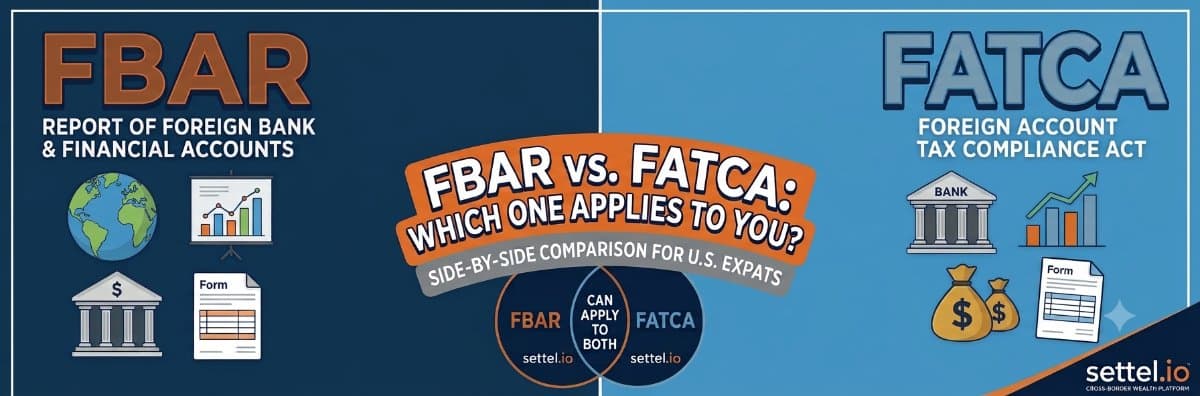
Suppose you relocated from Bangalore to Seattle a few years ago. You kept your NRO account for the rent on the flat back home, the PPF you've contributed to since your first job, and a small investment portfolio with Zerodha. None of it feels like "foreign money", because it's just your money, held in your home country.
The United States sees it differently. If you're a U.S. tax resident, you may have to report those accounts, possibly on two separate forms filed with two different agencies. Most people find this out when they sit down with a tax preparer in March. It's better to find out now.
Two forms, two laws
The two terms are often used interchangeably, which is the first source of confusion. FBAR (FinCEN Form 114) is required under the Bank Secrecy Act and filed with FinCEN, the Treasury bureau that fights financial crime. Form 8938 is an information statement required under FATCA and filed with the IRS as part of your annual income tax return. (FATCA is a wider regime. This article covers the individual reporting requirement on Form 8938.)
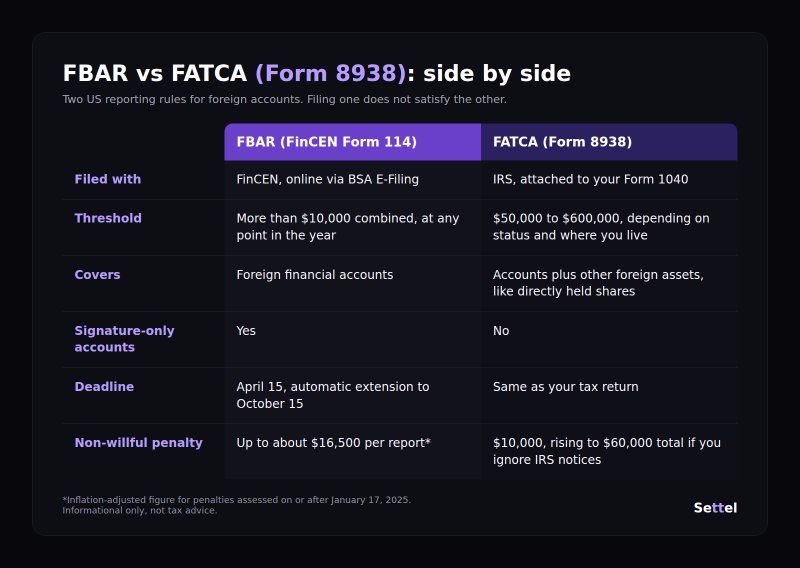
They rest on different laws, go to different agencies and cover different assets. Filing one does not satisfy the other. If both apply to you, you file both, and the same bank account appears twice.
The side-by-side
FBAR: lower than you think
The FBAR uses a single aggregate number. If the highest balances of all your foreign financial accounts, added together, exceed $10,000 at any point in the year, the FBAR applies to all of them.
The catch is that peaks count even when they fall in different months. Say your NRO account peaked at $4,000 in March, a UK current account at $4,000 in July, and a UAE savings account at $3,000 in November. The total is $11,000. You never held $10,000 abroad on any one day, but you still file.
The FBAR can also cover accounts you don't own, if you have signature authority. That means the authority to direct the financial institution to move or otherwise dispose of the account's assets. Being able to log in or view a balance isn't enough, and certain officer and employee exceptions apply. For example, a U.S. person in Dubai who has genuine signing authority over their employer's local account may have to report it, unless an exception applies.
FATCA: higher bar, wider net
Form 8938 thresholds depend on your filing status and where you live. You file if the aggregate value of your specified foreign financial assets is more than these amounts: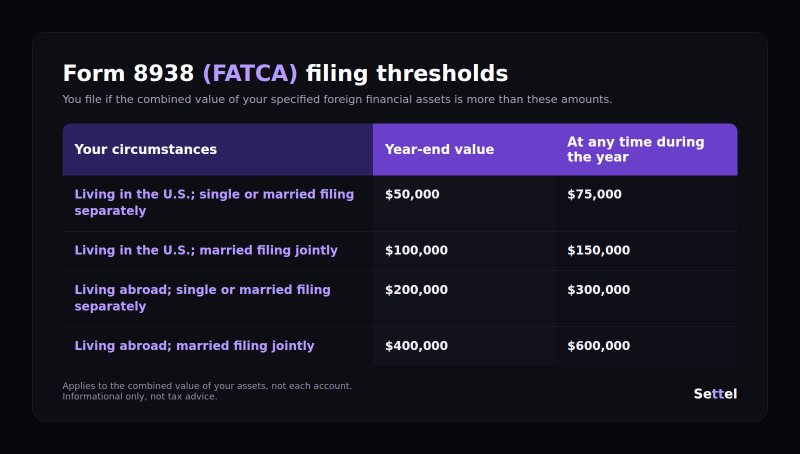
These apply to the combined value of your assets, not to each account. The higher "living abroad" figures apply only if you have a foreign tax home and meet the IRS bona fide residence or physical presence test (330 full days abroad in a 12-month period ending in the tax year being reported). Moving to London in October doesn't qualify you for that year.
The scope is also wider. Form 8938 covers foreign bank and brokerage accounts, foreign stocks and securities held directly, interests in foreign entities, and foreign life insurance or annuity contracts with cash value. Shares in a friend's UK startup, held in your own name, may belong on Form 8938 but not on the FBAR.
Form 8938 travels with your tax return, so if you aren't required to file a return, you don't file the form. The FBAR has no equivalent exit.
So which one applies to you?
The FBAR threshold is much lower, so it's the one most people hit first. If your foreign holdings are only ordinary bank and brokerage accounts, the usual pattern is:
• $10,000 or less combined (maximum values): generally no FBAR, and ordinarily no Form 8938.
• More than $10,000 but not exceeding either applicable Form 8938 threshold: generally FBAR only.
• Above your Form 8938 threshold: generally both, assuming you must file a U.S. income tax return.
If you also hold foreign shares directly, interests in foreign entities or other non-account assets, check Form 8938 separately. You can need it without needing an FBAR.
Two things from the opening example. The flat itself, if you own it directly, isn't reported on either form, but the NRO account receiving its rent can be. And India's tax-favoured treatment doesn't settle U.S. reporting. Form 8938 instructions specifically cover certain foreign pension and savings accounts, so don't assume your PPF is exempt. Ask a tax professional.
The thresholds are in dollars, but your accounts aren't. An INR or GBP balance that sits under the line in January can cross it after a strong year for the rupee or pound. For the FBAR, you convert each account's peak using the Treasury's year-end exchange rate, not the rate on the day of the peak.
What happens if you get it wrong
FBAR. For penalties assessed on or after January 17, 2025, a non-willful violation can bring a civil penalty of up to $16,536 per annual FBAR, not per account. That "per report" rule comes from the Supreme Court's 2023 decision in Bittner v. United States, and it made honest mistakes far less ruinous for people with many accounts. Willful violations are different. The maximum is the greater of $165,353 or 50% of the account balance at the time of the violation, for each unreported account. These are maximums, not automatic assessments.
Form 8938. Failure to file can attract an initial $10,000 penalty. If the failure continues for more than 90 days after the IRS mails you a notice, an additional $10,000 can apply for each 30-day period (or part of one), up to $50,000 extra. That's a potential $60,000 for failure to file, and separate penalties can apply on top, such as for understated tax. Reasonable-cause relief may be available.
If you've already missed years, the IRS has streamlined procedures for eligible taxpayers whose failures were non-willful. Relief isn't automatic, and the domestic and overseas procedures differ. Talk to a U.S. cross-border tax specialist before choosing a correction route, and don't file quietly and hope for the best.
Where Settel fits
Both forms require you to establish the maximum annual value of your reportable foreign accounts. Form 8938 also looks at year-end values and certain assets held outside financial accounts. When your holdings span India, the UK and the UAE in three currencies, gathering those figures can mean combing through twelve months of statements at each institution.
Settel keeps your account balances in one place, converted to one currency, so you can see roughly where you stand against the FBAR and Form 8938 thresholds during the year, not after. Form 8938 can also cover assets held outside accounts, such as directly held shares or interests in foreign entities, so treat the dashboard as a starting point, not your full Form 8938 position. In-year estimates are indicative: final filing calculations use the applicable year-end exchange rate.
Settel gives informational estimates, not tax advice. For your actual filing, check with a qualified U.S. tax professional.