

Selling stock or property across borders can create confusion over which country gets to tax your gains and at what rate. For US and UK expats working in tech or finance, understanding how capital gains tax rules differ by country, residency, and asset type is crucial. Missteps could lead to double taxation or missed reliefs. This guide breaks down the essentials and helps you make smarter decisions to keep more of your investment profits.
Table of Contents
- Capital Gains Tax Basics For Expats
- Types Of Taxable Assets And Gains
- Residency Rules And Cross-Border Tax Claims
- Double Taxation Agreements And Reliefs
- Common Mistakes, Compliance Tips, And Reporting
Key Takeaways
| Point | Details |
|---|---|
| Capital Gains Tax Rates Vary | The tax rate on capital gains depends on residency, citizenship, and the duration the asset is held, with long-term gains taxed at lower rates. |
| Importance of Basis Calculation | Accurate calculation of the cost basis, including all related fees, is essential to minimize taxable gain. |
| Residency Affects Tax Liabilities | Tax residency status influences the taxation of worldwide and US-source capital gains, making correct classification critical. |
| Double Taxation Treaties Provide Relief | Tax treaties can prevent double taxation on capital gains, but proper documentation and filing are necessary to claim benefits. |
Capital gains tax basics for expats
Capital gains are the profits you make when you sell an asset for more than you paid for it. If you bought Apple stock at $100 and sold it at $150, that $50 difference is your capital gain.
As an expat, this matters because the tax rate you pay depends on where you live, where you earned the income, and how long you held the asset. The US taxes its citizens on worldwide income, the UK taxes residents on worldwide gains, and other countries have their own rules entirely.
How capital gains are calculated
The difference between what you paid for an asset and what you sold it for is your gain. This starts simple: purchase price subtracted from sale price.
But "basis" (your cost) can include more than just the sticker price. Broker fees, commissions, and reinvested dividends all factor in. Getting this right matters because it directly reduces your taxable gain.
Long-term vs. short-term gains
The time you hold an asset dramatically changes your tax bill. Individual long-term capital gains held over one year are taxed at favorable rates: 0%, 15%, or 20%, depending on your income.
Short-term gains (assets held less than one year) are taxed as ordinary income at your marginal rate. For tech and finance professionals earning six figures, this can hit 37% federally.
Here's the key difference:
- Long-term gains: Lower rates, held over 12 months
- Short-term gains: Ordinary income rates, held under 12 months
- Timing matters: Selling in January versus December of the same year can cost you tens of thousands
US source gains for nonresident aliens
If you're not a US citizen but own US assets, special rules apply. Nonresident aliens may face a 30% tax on US source capital gains if they're present in the US for 183 days or more during the tax year.
This is where "tax home" becomes critical. Your tax home is typically where you have permanent housing, your family, or the center of your economic interests. This distinction determines whether gains are treated as US source or foreign source.
Special situations that reduce your tax
The tax code includes exceptions that can slash your bill:
- Primary residence exclusion: Sell your main home and exclude up to $250,000 in gains (single) or $500,000 (married)
- Retirement accounts: Gains in 401(k)s, IRAs, and equivalent plans are tax-deferred
- Losses: Capital losses can offset capital gains dollar-for-dollar
- Timing strategies: Realizing losses in one year to offset gains in another
Why this matters for your specific situation
As a tech or finance professional with assets across countries, you're likely holding appreciated stock, options that vest, or rental property gains. Each has different tax treatment based on where you live.
A developer in London with US tech stock holdings faces different rates than one in Dubai. Your residency status, citizenship, and the source of the asset all reshape the calculation.
Pro tip: Document your cost basis immediately when you buy an asset, including all fees and commissions. Most expats lose thousands because they can't prove what they originally paid, forcing the IRS to estimate your gains upward.
Types of taxable assets and gains
Not all assets trigger capital gains tax the same way. Understanding what you own and how it's taxed is the first step to avoiding surprise bills when you sell.
Capital assets include most property you own for investment or personal use. This covers stocks, bonds, real estate, vehicles, art, and jewelry. If you can sell it and make a profit, it likely qualifies as a capital asset.
The key question: Did the asset appreciate in value since you bought it? If yes, you owe tax on the gain when you sell.
To better understand which assets may trigger capital gains tax and how they are taxed, review this summary table:
| Asset Type | Taxable Event | Key Tax Considerations |
|---|---|---|
| Company stock options | Exercise and sale | Vesting date and exercise price |
| RSUs | Vesting and sale | Fair market value at vesting |
| Real estate | Sale of property | Primary residence exclusion |
| Cryptocurrency | Sale or trade | Each trade is a taxable event |
Stocks and investment securities
Tech professionals holding company stock options or RSUs face unique tax rules. When you exercise an option or an RSU vests, that's a taxable event—but the gain is calculated from vesting value, not purchase price.
If your RSU vests at $100 and you sell at $150, your capital gain is only $50. Many people mistakenly think the entire $150 is taxable.
Stock types matter:
- Common stock: Standard shares you buy on the market
- Restricted stock units (RSUs): Vested at fair market value; taxed as ordinary income at vesting
- Stock options: Only taxed when you exercise and sell; gain calculated from exercise price to sale price
- Inherited stock: Step-up in basis means you inherit at current value, not original purchase price
Real estate and property gains
Real estate gains hit differently for expats. If you own a rental property abroad, you may owe capital gains tax in both countries where the property sits and where you're taxed as a resident.

Your primary residence gets special treatment. The primary residence exclusion lets you exclude up to $250,000 (single) or $500,000 (married) of gains when you sell your main home, as long as you owned and lived there for at least 2 of the last 5 years.
But vacation homes, investment properties, and rental units? Full capital gains tax applies.
Cryptocurrency and digital assets
Crypto holdings create capital gains when you sell, trade, or convert to fiat currency. Buying Bitcoin at $30,000 and selling at $45,000 triggers a $15,000 capital gain.
Even trading one crypto for another (Bitcoin to Ethereum) counts as a taxable event. Many expats don't realize every trade creates a gain or loss you must report.
Long-term vs. short-term holdings
Long-term capital gains held over one year are taxed at preferential rates. Short-term gains held under one year are taxed as ordinary income at your marginal rate.
For high earners, this difference is massive. A short-term gain might hit 37% federally, while a long-term gain hits just 20%.
Holding an asset for 366 days instead of 365 days can save you thousands in taxes. Timing matters.
Pro tip: Create a spreadsheet tracking purchase date, purchase price, and vesting/exercise dates for all assets. Many expats mix up when they acquired something, costing them long-term rate treatment they actually qualified for.
Residency rules and cross-border tax claims
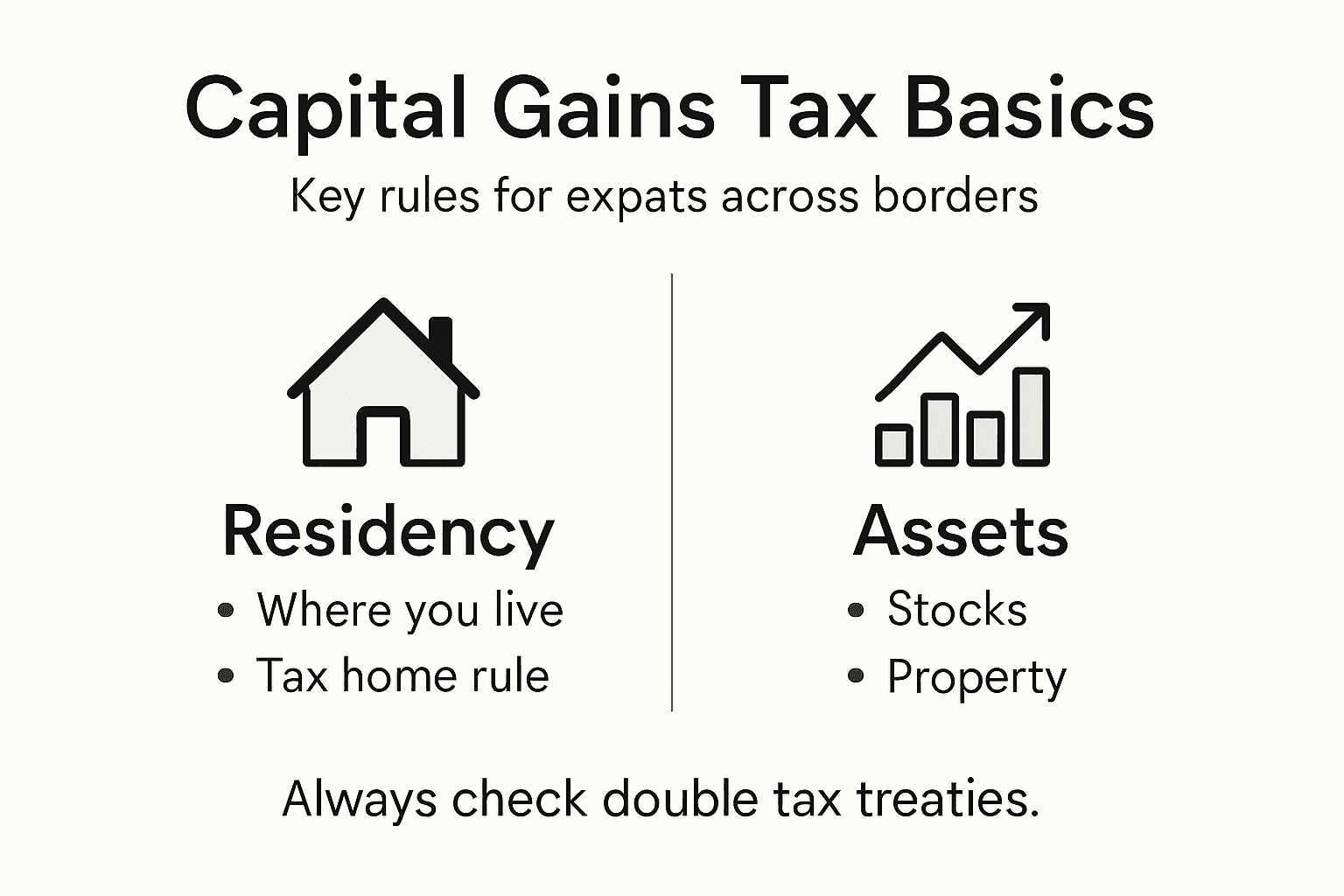
Your tax residency status determines which country gets to tax your capital gains. Get this wrong, and you could owe taxes in multiple countries on the same gain.
The IRS distinguishes between resident aliens and nonresident aliens based on specific tests. Your status controls whether you owe tax on worldwide capital gains or only U.S. source gains.
This is where expats get trapped. You might think you're no longer a U.S. tax resident because you left. Wrong.
The Green Card test
If you hold a U.S. Green Card, you're a resident for tax purposes, period. Even if you live abroad full-time, the IRS treats you as a U.S. resident alien.
This means your worldwide capital gains are taxable in the U.S., regardless of where the assets sit or where you live.
The Substantial Presence test
If you don't have a Green Card, the Substantial Presence test determines residency. You're a resident if you were present in the U.S. for:
- 183 days or more in the current year, OR
- 122 days or more in the current year plus weighted days from the prior two years
One day counts as one day in the current year, but only one-third of a day in the prior year and one-sixth in the year before that.
Many expats miscalculate this and accidentally become U.S. residents without realizing it.
Here's a quick reference comparing U.S. tax residency tests and their impact on capital gains tax obligations for expats:
| Residency Test | Requirement | Capital Gains Tax Impact |
|---|---|---|
| Green Card Test | Hold a U.S. Green Card | U.S. taxes worldwide capital gains |
| Substantial Presence | Days spent in the U.S. (weighted) | Possible U.S. resident status |
| Closer Connection | Demonstrate ties to other country | Can avoid U.S. tax on worldwide gains |
Closer Connection Exception
You can avoid U.S. resident status if you establish a closer connection to another country. This requires:
- A tax home in a foreign country
- Closer economic and personal ties to that country than the U.S.
- Filing Form 8840 with the IRS annually
This exception saves many expats from dual residency taxation, but you must prove it with documentation.
Cross-border capital loss allocation
When you have capital gains and losses across borders, special rules prevent double counting-1) of losses. You can't simply offset all foreign losses against U.S. gains without calculation.
The IRS uses allocation formulas to separate U.S. source gains from foreign source gains, then applies foreign tax credits to prevent double taxation.
This matters when you sell a London flat at a loss while realizing a gain on U.S. stock. You can't fully offset one with the other.
Double Taxation Agreements protect you
Most countries have tax treaties to prevent taxing the same income twice. The U.S. has treaties with the UK, Canada, Australia, and others.
These treaties typically specify which country gets primary taxing rights based on residency. Once you determine which country taxes your gain, you claim foreign tax credits in the other.
Your residency status isn't always obvious. If you're unsure whether you're a U.S. resident for tax purposes, clarify it before selling appreciated assets.
Pro tip: File Form 8840 (Closer Connection Statement) every year you're abroad and don't meet the Substantial Presence test. Missing even one year can flip your status to resident and trigger retroactive tax bills on worldwide gains.
Double taxation agreements and reliefs
Double taxation is the nightmare scenario: you owe capital gains tax in two countries on the same gain. Tax treaties exist specifically to prevent this.
The U.S. has income tax treaties with over 60 countries, including the UK, Canada, Australia, and most developed nations. These treaties reduce or exempt income taxes for residents on certain U.S.-source income, including capital gains.
But treaties only help if you know how to use them. Most expats don't.
How tax treaties allocate taxing rights
Double tax treaties follow standard frameworks that determine which country has the right to tax specific income. For capital gains, the key rule is usually: tax the country where the asset is located.
If you sell a U.S. stock, the U.S. taxes it. If you sell a UK property, the UK taxes it. But what if you're a U.S. citizen living in the UK?
Your residency determines how the other country taxes you. Most treaties give your country of residence the primary right to tax your worldwide income.
Treaty residence definition
Treaties define residency differently than the IRS does. Under the U.S.-UK treaty, you're a treaty resident if you're subject to tax in that country on your worldwide income.
This matters because it determines which country gets priority taxing rights. If you're a UK treaty resident, the UK typically taxes your worldwide gains first, and the U.S. claims a foreign tax credit.
Foreign Tax Credit vs. Exemption
Treaties offer two relief mechanisms:
- Foreign Tax Credit: You pay tax in both countries but claim a credit in your country of residence for taxes paid elsewhere
- Exemption method: Your country of residence exempts foreign-source income from tax entirely
The U.S. uses the foreign tax credit method. The UK uses exemption for foreign-source income. This affects your total tax bill significantly.
Treaty benefits require qualification
You can't automatically claim treaty benefits. Most countries require you to:
- Hold citizenship or residency in the treaty country
- Satisfy the treaty's residency definition
- File claims or certifications with your tax authorities
- Avoid being classified as a "dual resident" without treaty tie-breaker rules
Missing these steps means paying tax without relief.
Tie-breaker rules for dual residents
If you qualify as a resident in both countries, treaties use tie-breaker rules:
- Permanent home available (where you live)
- Center of vital interests (family, work, economic ties)
- Habitual abode (physical presence)
- Nationality (citizenship)
The treaty works through these tests sequentially until one country wins primary residency status.
Treaty benefits aren't automatic. You must affirmatively establish your treaty residency and claim the relief available.
Pro tip: Request a Competent Authority determination from your country's tax authority if you're caught between two countries' tax claims. This formal process forces both countries to negotiate and resolve conflicting residency claims, often eliminating double taxation entirely.
Common mistakes, compliance tips, and reporting
One missed filing deadline or underreported gain can trigger IRS penalties, interest, and an audit that derails your entire financial year. Compliance isn't optional for expats—it's the foundation of staying out of trouble.
The most dangerous mistakes aren't always what you'd expect. Many expats file returns but miss critical forms, fail to report foreign accounts, or claim treaty benefits they don't qualify for.
Failure to file is the biggest risk
Even if you owe no tax, you must file U.S. tax returns if your income exceeds the filing threshold. This applies to expats earning abroad.
The IRS imposes a 5% penalty per month for late filing, capped at 25% of unpaid tax. If you owe tax and don't file, penalties stack fast.
Failing to report a large capital gain while claiming you "didn't know" won't protect you. The IRS expects expats to understand their obligations.
Missing FBAR and Form 8938 filings
If you control foreign financial accounts exceeding $10,000 at any point during the year, you must file Form FinCEN 114 (FBAR). Failing to file carries penalties up to $10,000 or 50% of account value.
Form 8938 has a higher threshold ($200,000) but applies to broader asset classes. Confusing these two forms or missing either one is catastrophic.
These forms must be filed separately from your tax return. Many expats miss them entirely.
Common reporting mistakes to avoid
- Underreporting basis: Claiming you paid $50,000 for stock when you paid $60,000 inflates your gain
- Mixing long-term and short-term: Claiming short-term gains got long-term rates because you "thought" it was over a year
- Forgetting foreign exchange gains: Currency appreciation on foreign assets is taxable income
- Not documenting cost basis: The IRS will estimate your gain upward if you can't prove what you paid
- Claiming treaty benefits without residency: Trying to use a treaty benefit when you don't meet the treaty residency test
Documentation requirements
Keep meticulous records for every capital asset:
- Purchase date and price (including all fees)
- Sale date and price
- Holding period calculation
- FX rates used (if applicable)
- Broker statements or acquisition confirmations
- Proof of residency status (lease, utility bills, employment letters)
- Proof of tax home location
Missing even one document forces you to estimate, and the IRS always estimates against you.
Filing deadlines for expats
U.S. citizens abroad receive an automatic two-month extension to file their return, but interest accrues on unpaid tax from the normal deadline. An extension to file isn't an extension to pay.
This means: File by June 15th instead of April 15th, but pay any tax due by April 15th to avoid interest.
Documentation gaps are the primary reason expat audit rates exceed the general population average by 3x. Proof matters more than promises.
Pro tip: Use a dedicated spreadsheet or tax software to track every trade, sale, and acquisition with dates, prices, and FX rates the moment it happens. Reconstructing a year's worth of transactions during audit season is nearly impossible and always results in penalties.
Take Control of Your Cross-Border Capital Gains Tax with Settel
Navigating capital gains tax as an expat means managing complex residency rules, double taxation agreements, and multiple jurisdictions. The challenge of tracking investments, stock options, crypto, and property across countries like the US, UK, India, and UAE can create a maze of confusing tax obligations and deadlines. With terminology like "foreign tax credits", "closer connection exceptions", and "primary residence exclusion," it is easy to feel overwhelmed and risk costly mistakes.
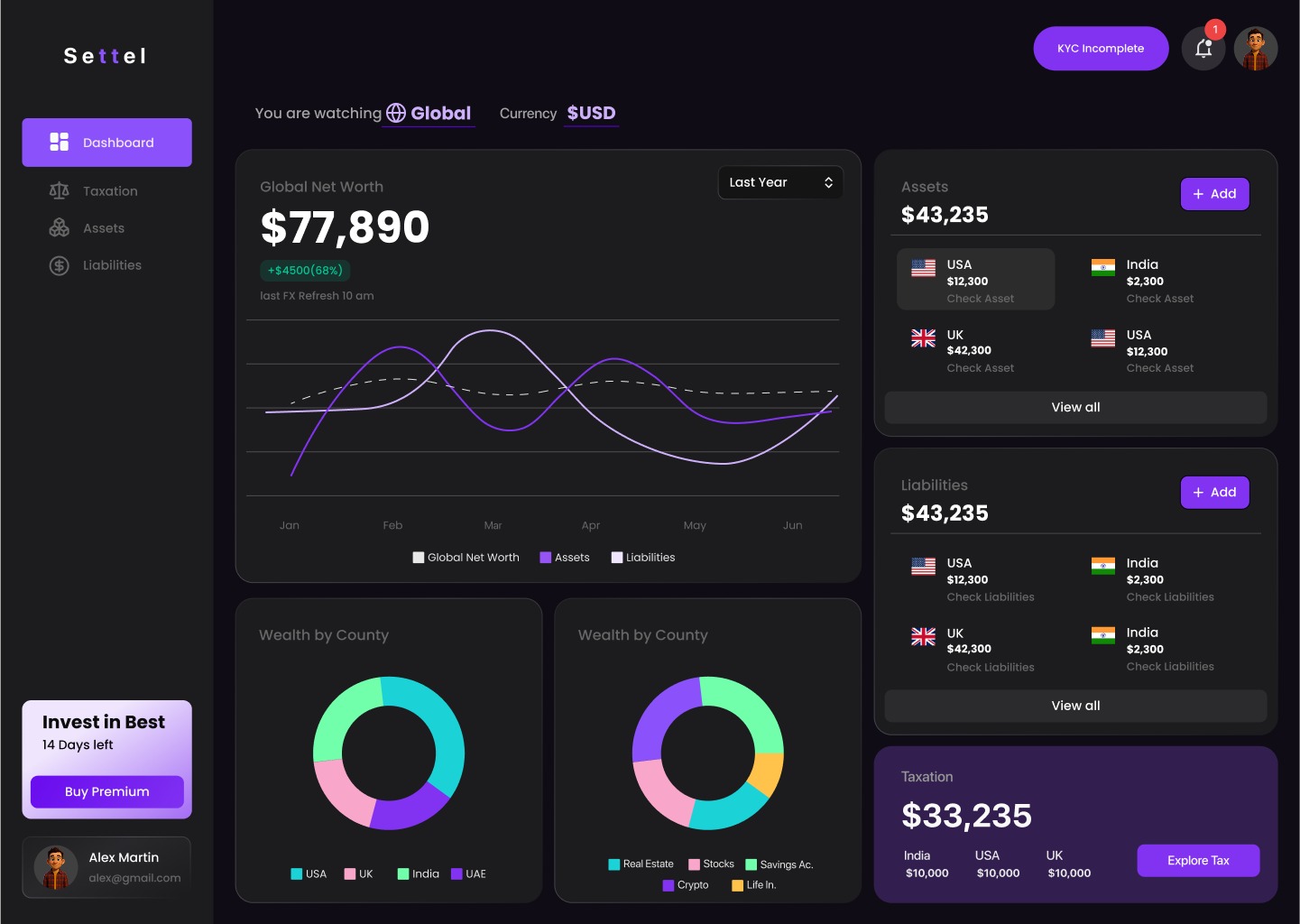
Settel is designed specifically for globally mobile professionals facing these challenges. Our global wealth and tax platform consolidates your multi-currency assets into one dashboard while analyzing your residency status and treaty benefits to estimate your capital gains tax across countries. Say goodbye to guesswork and penalties with automated compliance reminders and secure document extraction. Start simplifying your tax landscape now before the next filing deadline. Explore Settel and finally gain clarity and control over your cross-border capital gains tax today.
Frequently Asked Questions
What are capital gains?
Capital gains are the profits made from selling an asset for more than its purchase price. For instance, if you buy stock for $100 and sell it for $150, your capital gain is $50.
How does holding period affect capital gains tax?
The duration you hold an asset influences your tax rate. Long-term capital gains (held over a year) are taxed at lower rates, while short-term gains (held for less than a year) are taxed as ordinary income at your marginal rate.
What is the primary residence exclusion?
The primary residence exclusion allows you to exclude up to $250,000 of capital gains (or $500,000 if married) when you sell your main home, provided you owned and used it as your primary residence for at least two of the last five years.
What are some common mistakes expats make regarding capital gains tax?
Common mistakes include underreporting the cost basis, mixing up long-term and short-term gain classifications, failing to report foreign exchange gains, and claiming treaty benefits without meeting residency requirements.