
· 12 min read
Contents
- Key Takeaways
- Key Terms
- Best Stack by Profile
- How to Choose Your Stack
- What Each Layer Should Do
- Costs at a Glance
- The Tools
- Three Scenarios That Show the Numbers
- Compliance Calendar by Corridor
- How the Tools Stack Up
- Where Settel Fits
- FAQ
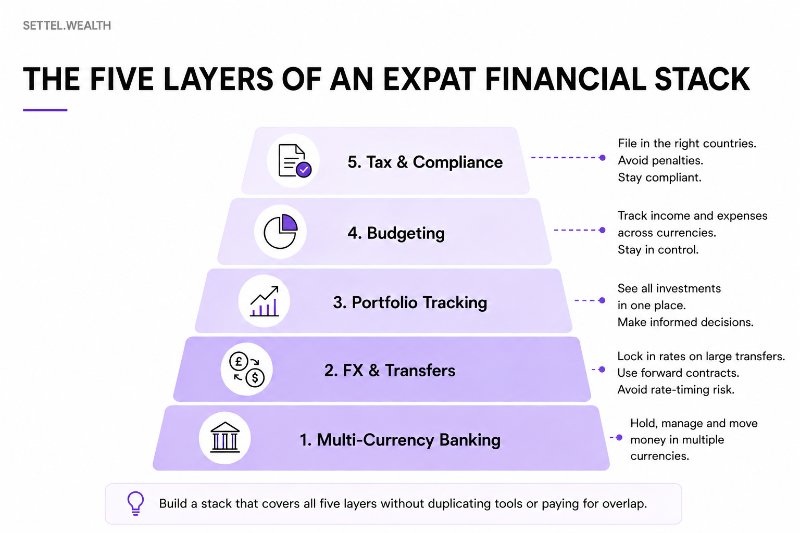
Most people managing money across two countries use the wrong tools for both. Not bad tools — just tools built for people whose entire financial life fits in one place. If you earn in one country, own assets in another, and are trying to figure out what you owe where, a standard budgeting app and your bank's exchange rate are not going to get you there.
This guide covers the tools that actually work in 2026 for the UK–India–UAE–US corridors: what each one does, what it
doesn't, what it costs, and how to build a stack that covers all five layers of a cross-border financial life without effort or paying for overlap.
Key Takeaways
- Traditional banks add 2–4% above the mid-market rate on currency conversions; specialist FX platforms typically charge 0.1–0.6%. On a £50,000 transfer that is a difference of up to £1,700.
- UK expats with foreign income over £300 must file a UK Self Assessment — online deadline 31 January 2027 for the
2025–26 tax year. - NRIs with Indian income must file an Indian ITR-2 — standard deadline 31 July 2026 for FY 2025–26.
- US citizens abroad must file a US federal return regardless of where they live. FBAR is required if foreign accounts exceed
$10,000 in aggregate. Form 8938 applies above $200,000 in foreign assets for single filers abroad. - The FEIE for the 2025 tax year is $130,000 per qualifying person. The FTC is often more beneficial for expats in high-tax countries like the UK.
- No single tool covers all five layers of a cross-border financial stack. A combination of budgeting, portfolio, banking, FX, and tax tools is needed.
- Wise and Revolut serve the same banking category. The key difference since March 2026: Revolut is now FSCS-protected
(up to £85,000 for UK customers); Wise is not.
Key Terms
DTAA (Double Taxation Avoidance Agreement): A treaty between two countries that determines which country taxes which income
and prevents the same income being taxed twice. India has DTAAs with both the UK and the US. The UK–India DTAA governs how
rental income, dividends, and employment income are taxed when you live in one country and earn in the other.
FEIE (Foreign Earned Income Exclusion): A US tax provision allowing US citizens and resident aliens abroad to exclude up to
$130,000 (2025 tax year) of foreign earned income from US federal income tax. Filed on Form 2555. Applies to earned income
only - not dividends, rental income, or capital gains. (IRS — Foreign Earned Income Exclusion)
FTC (Foreign Tax Credit): A US tax provision that credits foreign taxes paid against US tax owed on the same income.
Filed on Form 1116. Often more beneficial than FEIE for expats in high-tax countries like the UK.
FBAR (Foreign Bank Account Report, FinCEN Form 114): A US reporting requirement for any US person whose foreign financial
accounts exceed $10,000 in aggregate at any point during the year. Filed separately with FinCEN — not with the IRS, not
attached to your tax return. (IRS — FBAR vs Form 8938)
Form 8938 (FATCA): A US reporting requirement for specified foreign financial assets above higher thresholds ($200,000 at
year-end or $300,000 at any point for single filers abroad). Filed with your Form 1040. Covers a broader range of assets
than FBAR. Filing one does not satisfy the other. (IRS — About Form 8938)
SRT (Statutory Residence Test): The UK framework that determines whether you are a UK tax resident in a given year,
based on day-count and personal ties to the UK. Your UK tax obligations depend on this status, not just your nationality or employment.
ITR (Income Tax Return): India's annual tax filing. NRIs with Indian-source income above the basic exemption limit must
file an ITR-2. Filed at incometax.gov.in.
Best Stack by Profile
What is the minimum expat finance stack?
It depends on your corridor and filing obligations, but for most people managing finances across two or more countries, three to four tools are needed. No single platform covers all the bases.
Profile A — UK resident with Indian income
PocketSmith (multi-currency budgeting) + Delta (portfolio tracking for Indian assets) + Wise or Revolut (banking) + Settel (UK–India DTAA tax modelling and residency tracking). Add MTFX if you make large annual rupee–sterling transfers.
Profile B — US citizen living abroad (UK, India, or UAE)
MyExpatTaxes or Greenback Tax Services (FBAR, Form 8938, FEIE vs FTC) + Wise (multi-currency banking) + Settel (UK, India, or UAE tax and residency layer). Add Delta if you hold assets across multiple brokerages.
Profile C — UAE-based professional with UK or Indian assets
MTFX (AED transfers for property purchase or remittance) + Delta (portfolio tracking) + Revolut (banking with FSCS protection if UK-based) + Settel (non-resident landlord UK tax obligations, Indian ITR modelling if applicable).
Decision rule: If FSCS deposit protection matters → Revolut. If you prioritise broadest currency coverage and no monthly fees → Wise. If you are making a large one-off transfer above £20,000 → MTFX forward contract. If you need US expat compliance → MyExpatTaxes or Greenback, not a generic tax app.
How to Choose Your Stack
Profile A - UK resident with Indian income
You have UK Self Assessment obligations (including the SA106 foreign income supplementary page) and Indian ITR-2 obligations
as a non-resident. The UK–India DTAA prevents double taxation but requires filing in both countries. You need: multi-currency
budgeting, Indian portfolio tracking, GBP–INR banking, and a tax layer that models the DTAA interaction.
Profile B - US citizen living abroad
US citizenship-based taxation means you file a US return every year regardless of residence. Foreign accounts above $10,000
trigger FBAR. Foreign assets above $200,000 trigger Form 8938. The FEIE ($130,000 for 2025) or FTC reduces your US liability -
which is more beneficial depends on your income level and the tax rate in your country of residence. You need: dedicated US
expat tax software for FBAR and Form 8938, plus separate tools for your country-of-residence obligations.
Profile C - UAE-based professional with UK or Indian assets
UAE has no personal income tax, but UAE residency does not automatically exempt you from UK or Indian tax obligations. UK
rental income is taxable in the UK for non-residents. Indian income above the exemption threshold requires ITR filing regardless of where you live. The UK Statutory Residence Test may still classify you as UK-resident depending on your day-count and ties. You need: FX management for large transfers, portfolio tracking across jurisdictions, and a tax layer that models your actual residency position.
What Each Layer Should Do
Banking: Hold multiple currencies, receive local payments in GBP, INR, AED, and USD, send internationally at near mid-market rates.
FX: Manage large planned conversions using forward contracts or rate alerts. Not for day-to-day spending — for transfers large enough that the rate materially affects the outcome.
Portfolio tracking: Consolidated view of assets across brokerages, Demat accounts, and crypto exchanges — with returns
calculated net of currency movements, not just nominal local currency performance.
Budgeting: Multi-currency cash flow visibility — income in one currency, expenses in two or three others, net worth in your chosen base currency. Calendar-based forecasting.
Tax and compliance: This is where most tools fail expats. You need jurisdiction-specific modelling of how your income sources interact with residency rules, DTAA provisions, and foreign tax credits across your active countries. A calculator that handles one country at a time is not the same thing.
The thing I see most often when people come to Settel with a UK–India position is that they have been using a domestic UK
tax calculator and manually adding the Indian income as an afterthought. The DTAA interaction - what gets credited, what gets reported where, what changes based on whether your Indian income is rental versus investment versus employment - is exactly what a single-country tool cannot model. That gap is what Settel is built to close. For a step-by-step look at how this works in practice, see our guide on wealth tracking for expats across the UK, India, UAE, and US.
Costs at a Glance
| Cost type | Traditional bank | Specialist platform |
|---|---|---|
| FX conversion markup | 2–4% above mid-market | 0.1–0.6% above mid-market |
| Cost on £50,000 transfer | £1,000–£2,000 | £50–£300 |
| Monthly account fee | Varies (often £0 for current accounts) | £0–£55 depending on tier |
| Forward contract | Rarely available to personal clients | Available via MTFX and similar |
| FBAR/Form 8938 filing | N/A | £0–£500+ depending on complexity |
FX markup figures sourced from CurrencyTransfer.com industry analysis (May 2026) and corroborated across multiple specialist
provider disclosures.
The Tools
Pricing verified June 2026. Tool features and pricing change —
check provider sites before committing.
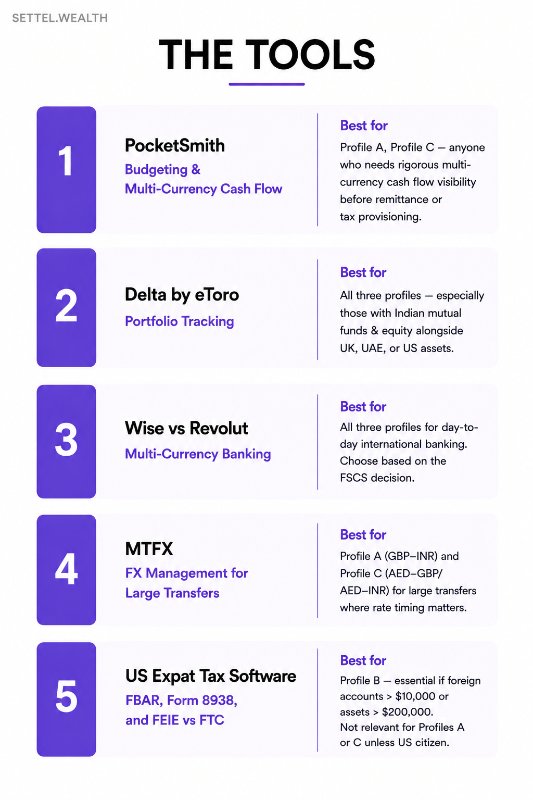
PocketSmith - Budgeting and Multi-Currency Cash Flow
What it does in one sentence: Tracks income and spending across multiple currencies against a single base currency, with calendar-based cash flow forecasting up to decades ahead.
PocketSmith connects to 12,000+ banks and financial institutions worldwide via Yodlee and direct feeds. It shows account balances in their original currencies and calculates net worth using live exchange rates against your chosen base currency.
(pocketsmith.com)
Typical use case: A UK-based expat wants to see her GBP salary, INR rental income, and AED savings account in one dashboard, with net worth calculated in GBP and a cash flow forecast showing when she will need to remit funds from India.
Pricing: Foundation at $9.99/month (limited connections); Fortune at $26.66/month (unlimited connections and full forecasting). India and UAE bank feeds available via Yodlee - coverage varies by institution, confirm your specific banks before committing.
Limitations: No tax form automation. No DTAA modelling. No residency tracking. A budgeting tool only.
Best for: Profile A, Profile C - anyone who needs rigorous multi-currency cash flow visibility before they can make intelligent decisions about remittance timing or tax provisioning.
Delta by eToro - Portfolio Tracking
What it does in one sentence: Consolidates stocks, ETFs, mutual funds, crypto, NFTs, and forex across all connected brokers and exchanges into one read-only performance dashboard.
Delta is owned by eToro and available on iOS, Android, Mac,and Windows. It is read-only - it cannot execute trades, hold funds, or move money.
(delta.app)
Typical use case: An NRI in London holds Indian equity mutual funds in a Demat account, a Stocks and Shares ISA with a UK broker, and ETH in a crypto wallet. Delta shows the combined portfolio value in GBP, with performance net of currency movements between INR, GBP, and USD.
Pricing (updated January 2026): Basic (free) - up to 10 assets, unlimited account connections; PRO - up to 40 assets
at $53.88/year; PRO+ - unlimited assets at $107.88/year. Pricing varies by region and store taxes.
Limitations: Free tier capped at 10 assets since January 2026. No tax calculation. No DTAA modelling. A tracker only.
Best for: All three profiles - particularly anyone with Indian mutual fund and equity holdings alongside UK, UAE, or US assets who has been tracking everything in a spreadsheet.
Wise vs Revolut - Multi-Currency Banking
What is the difference between Wise and Revolut for expats?
Both offer multi-currency accounts at near mid-market rates and are widely used in the UK–India–UAE–US corridors. The key
distinction since March 2026 is deposit protection.
Wise holds 40+ currencies including GBP, INR, and AED. No monthly fee. Transfers to 160+ countries. Transaction fees range from approximately 0.33% to 2% depending on the currency pair and payment method. Wise is an e-money account - funds
are safeguarded per FCA regulatory obligations but are not FSCS-protected.
(wise.com)
Revolut holds up to 38 currencies at the mid-market rate on weekdays; a 0.5% weekend markup applies on the Standard
plan. Free tier available; paid plans from £3.99/month. Revolut received a full UK banking licence from the PRA in March 2026 — eligible UK deposits are now FSCS-protected up to £85,000. Note: Revolut is not yet a licensed bank in the US (OCC charter application pending as of April 2026). (revolut.com)
| Feature | Wise | Revolut |
|---|---|---|
| Currencies held | 40+ (incl. INR, AED) | 38 |
| Monthly fee | £0 | £0–£55 |
| FSCS protection (UK) | No (e-money account) | Yes (from March 2026) |
| Weekend FX markup | None | 0.5% on Standard |
| US banking licence | No (e-money) | No (OCC pending) |
Choose Wise if: broadest currency coverage matters, no monthly fee is a priority, or you are in the US corridor where FSCS is irrelevant.
Choose Revolut if: you are UK-based, you hold meaningful balances in the account, and FSCS deposit protection matters.
Limitations for both: Neither models your tax position, residency status, or DTAA interaction. Banking tools only.
Best for: All three profiles for day-to-day international banking. Choose based on the FSCS decision above.
MTFX - FX Management for Large Transfers
What it does in one sentence: Holds funds in 50+ currencies, executes forward contracts to lock future exchange rates, and
sends alerts when your target rate is reached.
MTFX is a Canadian-regulated FX provider (FINTRAC) operating since 1996. It offers exchange rates 2–5% better than major
banks per MTFX's own published figures, serving both personal and business clients. The platform is primarily positioned for
business use; personal accounts are available but require speaking with a currency specialist to set up. (mtfxgroup.com)
Typical use case: Fatima is purchasing a £200,000 UK property, funded by AED savings, with completion in four months.
A forward contract with MTFX locks the AED/GBP rate today. A 5% movement in that rate over four months - not unusual -
would cost AED 46,500 at the day-of-transfer rate. The forward contract eliminates that risk entirely.
Pricing: No monthly fee; account fees and FX margins vary by transaction size and currency pair. Contact MTFX for rates
on specific corridors.
Limitations: Not a budgeting tool, portfolio tracker, or tax compliance platform. Primarily B2B in positioning.
Best for: Profile A moving large sums between GBP and INR. Profile C executing AED-to-GBP or AED-to-INR property or
investment transfers where rate timing matters.
US Expat Tax Software — FBAR, Form 8938, and FEIE vs FTC
What it does in one sentence: Automates the US-specific tax filing obligations that apply to American citizens abroad regardless of where they live.
The filing requirements for US citizens do not stop at the border:
FBAR: Required if foreign accounts exceed $10,000 in aggregate at any point during the year. Filed separately with FinCEN - not with the IRS.
Form 8938: Required for specified foreign assets above $200,000 at year-end (or $300,000 at any point) for single filers abroad. Filed with Form 1040. Covers a broader range of assets than FBAR. Both may be required independently. (IRS comparison)
FEIE vs FTC: The FEIE excludes up to $130,000 of foreign earned income from US tax for the 2025 tax year (confirmed from IRS Form 2555 instructions). The FTC credits foreign taxes paid against US tax owed. For expats in high-tax countries like the UK - where the UK income tax rate may exceed the US rate - the FTC is often more beneficial. Which reduces your liability more depends on your specific income level and the tax paid in your country of residence.
Two verified platforms:
MyExpatTaxes (myexpattaxes.com)
- DIY software guiding US expats through Form 8938 and FBAR alongside their federal return, with professional review
options.
Greenback Tax Services
(greenbacktaxservices.com)
- a US-expat specialist firm handling FBAR, Form 8938, and FEIE vs FTC optimisation.
Limitations: Neither handles UK Self Assessment, Indian ITR, or UAE-specific obligations. US compliance only.
Best for: Profile B - essential if you have foreign accounts above $10,000 or foreign assets above $200,000. Not relevant for Profiles A or C unless they also hold US citizenship.
Three Scenarios That Show the Numbers
Scenario 1 - Profile A: UK Salary and Indian Rental Income
Who: Priya. UK resident, 4 years. £80,000 GBP salary. ₹10 lakh (approx. £9,000) annual rental income, Pune. Indian
mutual funds valued at ₹40 lakh.
The FX cost: Priya remits ₹10 lakh to the UK each year.
At a typical UK bank retail markup (2–3% above mid-market): she loses £180–£270 per transfer on conversion alone.
At a specialist platform (0.1–0.6%): she pays £9–£54.
Over five years the difference at the bank rate is £900–£1,350 versus £45–£270 at a specialist rate - purely on the conversion cost, before any tax consideration.
The tax position: The UK–India DTAA prevents double taxation but requires filing in both countries. Priya files a UK Self Assessment (SA106 foreign income page for the rental income) and an Indian ITR-2 as a non-resident. India taxes the rental income at source; Priya claims a foreign tax credit in the UK for Indian tax already paid, subject to DTAA provisions.
The deadlines: Indian ITR-2: 31 July 2026. UK Self Assessment (online): 31 January 2027. Missing either triggers penalties - ₹5,000 plus 1% monthly interest in India; £100 immediately and £10/day after three months in the UK.
Her stack: PocketSmith (GBP/INR cash flow). Delta (mutual fund and ISA performance). MTFX (annual rupee remittance).
Settel (UK–India DTAA tax modelling and deadline tracking).
Scenario 2 - Profile B: US Citizen in the UK
Who: James. US citizen. 4 years in London, UK work visa. £90,000 UK salary. US brokerage account: $220,000.
The filing obligations:
- FBAR: James's UK current account occasionally exceeds $10,000 equivalent → FBAR required (FinCEN Form 114).
- Form 8938: His $220,000 US brokerage exceeds the $200,000 year-end threshold for single filers abroad → Form 8938
required with his Form 1040.
The FEIE vs FTC question: James can exclude up to $130,000 of his UK salary from US tax via the FEIE (2025 tax year, per
IRS Form 2555 instructions). Alternatively, he can claim a Foreign Tax Credit for UK income tax already paid. In the UK, higher-rate income tax is 40%. US federal income tax at his income level is typically lower - meaning the FTC route may leave excess credits he cannot use, while FEIE cleanly eliminates US tax on the excluded amount. Which is better requires running his specific numbers. This is precisely what MyExpatTaxes and Greenback Tax Services calculate.
The deadlines: FBAR: 15 April 2026, auto-extended to 15 October 2026. Form 1040 + Form 8938: 15 June 2026 for US persons abroad; extendable to 15 October 2026.
His stack: Wise (UK/US banking). MyExpatTaxes or Greenback (FBAR, Form 8938, FEIE vs FTC). Settel (UK tax position and
Self Assessment).
Scenario 3 - Profile C: UAE-Based, UK Property Purchase
Who: Fatima. Emirati national. Based in Dubai, 3 years.Purchasing a £200,000 UK buy-to-let property from AED savings. Completion in 4 months.
The FX exposure:
At today's indicative rate: £200,000 ≈ AED 940,000.
A 5% AED/GBP movement over 4 months changes the cost by AED 47,000 (approx. £10,000). This is not unusual volatility for this pair.
Bank retail rate (2–3% above mid-market) on £200,000: additional cost of £4,000–£6,000 versus mid-market.
Specialist FX forward contract (0.1–0.6%): £200–£1,200.
Using MTFX to lock the rate today eliminates both the rate movement risk and the bank markup. Difference on this single transfer: potentially £3,000–£5,800 versus the bank route.
The tax consequence: Once the property generates UK rental income, Fatima has a UK tax obligation as a non-resident
landlord regardless of her UAE residency. She must register with HMRC's Non-Resident Landlord Scheme and file a UK Self
Assessment annually.
Her stack: MTFX forward contract (AED/GBP transfer). Delta (property alongside other assets). Settel (UK non-resident landlord tax obligations and Indian ITR modelling if applicable).
Compliance Calendar by Corridor
Verify current deadlines before filing - governments can and do extend or change them. Deadlines shown are for the 2025–26
(UK/India) and 2025 (US) tax years.
| Obligation | Who It Applies To | Standard Deadline | Late Penalty |
|---|---|---|---|
| UK Self Assessment - online | UK residents with foreign income > £300 | 31 Jan 2027 | £100 immediately; £10/day after 3 months |
| UK Self Assessment - paper | UK residents filing on paper | 31 Oct 2026 | £100 immediately |
| India ITR-2 - NRI/salaried | NRIs with Indian-source income | 31 Jul 2026 | ₹1,000–₹5,000 + 1%/month on unpaid tax |
| India ITR - business (non-audit) | Business income, no audit required | 31 Aug 2026 | As above |
| India belated return | Missed original deadline | 31 Dec 2026 | Late fee + interest applies |
| US FBAR (FinCEN Form 114) | US persons with foreign accounts > $10,000 | 15 Apr 2026; auto-extended to 15 Oct 2026 | Up to $10,000/violation (non-willful) |
| US Form 1040 + Form 8938 | US persons abroad with foreign assets > $200,000 (single) | 15 Jun 2026; extendable to 15 Oct 2026 | From $10,000 for missed Form 8938 |
Sources:
gov.uk — Self Assessment deadlines ·
incometax.gov.in — ITR e-filing portal ·
IRS — FBAR vs Form 8938 ·
IRS — About Form 8938
For a full worked walkthrough of how residency tests, DTAA allocation, and foreign tax credits combine to determine what you actually owe, see How to Calculate Your Global Expat Tax Obligations in 2026.
How the Tools Stack Up
| Tool | Layer | Key feature | 2026 pricing | Best for |
|---|---|---|---|---|
| PocketSmith | Budgeting | 12,000+ institution feeds; multi-currency cash flow | $9.99–$26.66/month | Profile A, C |
| Delta by eToro | Portfolio | Stocks, ETFs, crypto, mutual funds, NFTs - read-only | Free–$107.88/year | All profiles |
| Wise | Banking | 40+ currencies incl. INR + AED; no monthly fees | Transaction-based | All profiles |
| Revolut | Banking | 38 currencies; FSCS-protected in UK (from March 2026) | Free–£55/month | Profile A, C (UK-based) |
| MTFX | FX | 50+ currencies; forward contracts; rate alerts | Account fees vary | Profile A, C - large transfers |
| MyExpatTaxes / Greenback | Tax - US | FBAR, Form 8938, FEIE vs FTC | Varies by service | Profile B only |
| Settel | Tax - cross-border | Multi-jurisdiction DTAA modelling; day-count tracking; deadline reminders | settel.io | All profiles |
Where Settel Fits
The tools in this guide are good at what they do. None of them now what you owe in two countries at once — or whether the
DTAA between those countries means you should file differently than you think.
Settel's Smart Tax Engine models your residency status, income sources, applicable Double Taxation Agreements, and foreign tax
credits across the UK, India, UAE, and US simultaneously, and shows your estimated tax obligations in each jurisdiction. Not a domestic calculator with a currency converter added. A cross-border tax modelling engine built for the corridors Settel's audience actually uses.
The day-count tracker monitors your UK Statutory Residence Test position and Indian residential status in real time. Compliance
deadline reminders surface what you owe and when. Settel AI helps users understand their full wealth and tax picture across jurisdictions and surface optimisation options in plain language.
You probably need a professional for the actual filing. What Settel gives you is the numbers before that conversation - your residency position, your estimated exposure, your deadlines - so you walk in knowing what you are dealing with rather than finding out what it costs.
Start with the Settel dashboard → app.settel.io
FAQ
What tools do UK residents with Indian income actually need?
Three, at minimum. PocketSmith for cash flow across GBP and INR, Delta for tracking your Indian and UK investments in one
place, and Settel to model what you owe under the UK–India DTAA. Add Wise or Revolut for day-to-day banking, and MTFX if you
are moving large sums between currencies and the conversion rate matters. US expat software is irrelevant unless you also hold
US citizenship.
Is there a tax app that works across UK, India, and UAE?
The honest answer is that most tax apps work for one country and bolt on currency conversion for the others. That is not the same thing. Settel is built specifically for the UK–India– UAE–US corridors and models how income, residency status, and DTAA provisions interact across countries - not just in parallel. If you are also a US citizen, you need MyExpatTaxes or Greenback on top of that for FBAR and Form 8938. Most people in these corridors need both layers. Start by understanding your cross- border position, then file with a professional or the right
country-specific tool.
Is there a wealth tax in the UK that expats need to know about?
No. The UK has no annual wealth tax. UK residents - including expats - pay Income Tax, Capital Gains Tax, and Inheritance Tax where applicable, but there is no levy on net wealth itself. What catches expats off guard is the Statutory Residence Test: UK tax obligations depend on your day-count and ties to the UK, not just your employment or nationality. Settel's day-count tracker monitors your SRT position in real time.
Wise vs Revolut for expats: what are the three key differences?
First, deposit protection: Revolut is now FSCS-protected up to £85,000 for UK customers following its full UK banking licence
in March 2026. Wise is an e-money account - funds are safeguarded but not FSCS-covered. Second, currency range: Wise
holds 40+ currencies versus Revolut's 38. Third, fees: Wise charges no monthly fee; Revolut's Standard plan is free but
applies a 0.5% markup on weekend currency exchanges. For most UK-based expats holding meaningful balances, Revolut's deposit
protection is the deciding factor. For US-corridor users where FSCS is irrelevant, Wise's broader currency coverage edges it.
What expat tax services are available for UK residents with Indian income?
UK residents with Indian income - rental income, mutual fund returns, dividends, or employment income - have obligations in both countries under the UK–India Double Taxation Agreement. You will typically need to file a UK Self Assessment (including the SA106 foreign income page) and an Indian ITR-2 as a non-resident. Settel's Smart Tax Engine models the DTAA interaction. For complex situations involving significant Indian capital gains, business income, or RNOR status, a qualified tax adviser with UK–India corridor experience is advisable.
Informational only - not financial advice. Settel is a tracking and calculation tool. Always consult a qualified tax professional for advice specific to your situation.